

 vi
 10-Jun-2026
 129,390
The Structural Technology Behind EVO/EVO+ ICL Lenses
Before 2016, long-term studies of the Visian ICL V4 lens model showed that after a 10-year follow-up period, researchers observed a significant incidence of secondary cataract formation among highly myopic patients, with 18.3% of eyes requiring phacoemulsification surgery to remove the opacified crystalline lens. At the same time, the incidence of secondary glaucoma (elevated intraocular pressure) requiring medical treatment with intraocular pressure-lowering medications reached 12.9% after one decade.
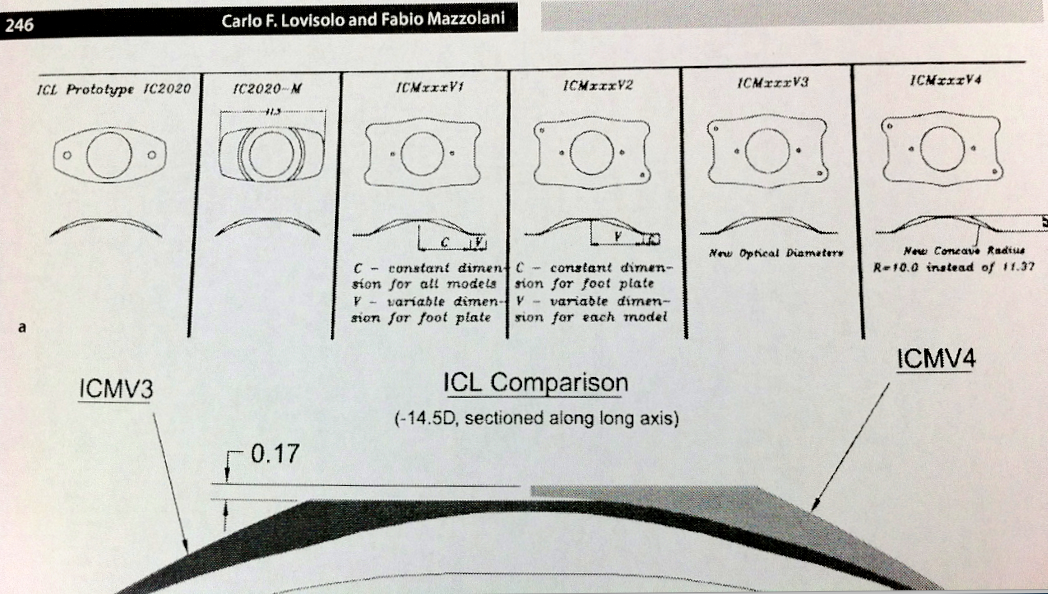
Evolution of Phakic ICL lens generations illustrated in ophthalmology textbooks
To comprehensively address the limitations of the V4 generation, STAAR Surgical (the only ICL manufacturer approved by the U.S. Food and Drug Administration – FDA) successfully developed and introduced a new-generation lens platform known as EVO/EVO+ ICL (Phakic ICL) (technically designated as the V4c version).
The EVO ICL was first commercialized in 2011, while EVO+ ICL was introduced in 2016 in the European Union (EU). Today, both lens models are used in more than 75 countries and territories worldwide.
1. CentraFLOW Central Flow Technology (KS-AquaPORT®)
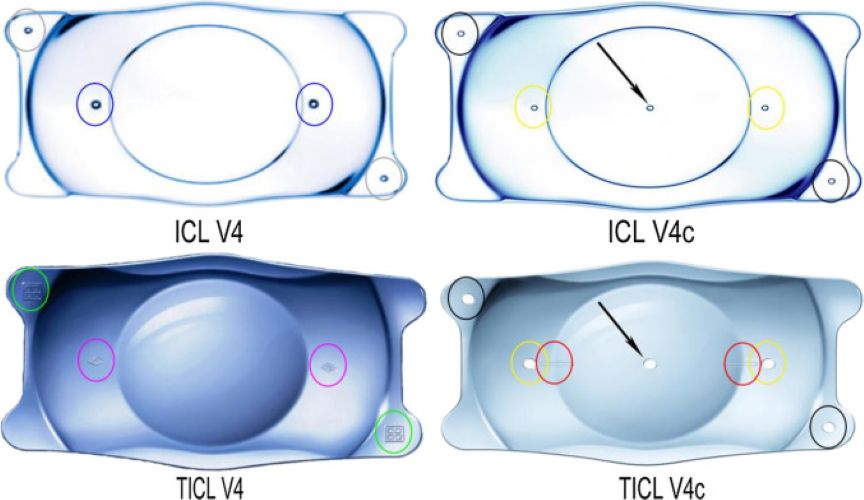
CentraFLOW (KS-AquaPORT®) technology improvement in Phakic ICL
The most fundamental innovation of EVO ICL is the integration of a microscopic central flow port located at the center of the lens, known as the Aquaport, with a precisely engineered diameter of 0.36 mm. This dimension was determined using fluid dynamics modeling to ensure continuous aqueous humor circulation, balancing pressure between the anterior and posterior chambers without affecting the refractive function of the lens or causing light scattering that could compromise visual quality.
The introduction of the Aquaport completely eliminated the need for peripheral iridotomy, making the surgical procedure more streamlined while minimizing microscopic surgical trauma.
2. Premium Biocompatible Collamer Material
The EVO ICL lens is manufactured from Collamer – a proprietary material composed of a combination of Polymer and purified Collagen. The most remarkable characteristic of this material is its exceptional level of biocompatibility.
When positioned within the posterior chamber (between the posterior surface of the iris and the anterior surface of the crystalline lens), the lens carries a slight negative electrical charge similar to that of natural intraocular tissues, helping prevent inflammatory cell adhesion, avoiding immune rejection, and maintaining lifelong optical clarity within the intraocular environment.
Comparison Table of Technical Characteristics Between Two Generations of ICL Lenses
| Analysis Criteria | Older Generation (Visian ICL V4) | New Generation (EVO/EVO+ ICL) |
|---|---|---|
| Geometric Structure | Closed, continuous flat surface without an aqueous humor flow port. | Integrated Aquaport micro-flow port measuring 0.36 mm at the center of the lens (CentraFLOW Technology). |
| Preoperative Procedure Requirement | Mandatory peripheral laser iridotomy performed 1–2 weeks before surgery to prevent acute intraocular pressure elevation. | No iris intervention required. The surgical procedure is performed directly in a single stage. |
| Aqueous Humor Dynamics | Restricted circulation at the ciliary sulcus and the anterior surface of the natural crystalline lens. | Natural aqueous humor circulation continuously nourishes the crystalline lens and maintains intraocular pressure balance. |
| Cataract Complication Rate (After 5–10 Years) | Reported to reach up to 18.3% in highly myopic patients. | Reduced to below 1% (multicenter studies report rates approaching 0%). |
| Secondary Glaucoma Rate | Reached 12.9% due to mechanical pupillary block or angle closure. | Rare (Rate < 0.5%, primarily associated with lens sizing inaccuracies). |
Safety and Effectiveness of Phakic ICL
The safety and effectiveness of the current EVO/EVO+ ICL generation have been demonstrated through numerous large-scale clinical studies published in internationally recognized ophthalmology journals such as the Journal of Cataract & Refractive Surgery (JCRS) and the American Journal of Ophthalmology.

Safety and effectiveness of Phakic ICL
A meta-analysis tracking data from more than 4,000 eyes implanted with EVO ICL lenses over a 5- to 7-year period showed that the incidence of visually significant cataract formation decreased to a minimal level (below 0.2% in subjects under 40 years old).
For the complication of elevated intraocular pressure, fluid circulation through the Aquaport helps stabilize intraocular pressure within the first 24 hours after surgery and maintain it consistently over the following years.
According to medical device registration records, EVO/EVO+ has never been withdrawn from any market worldwide due to issues related to the safety or effectiveness of the product.
Optical Characteristics of Phakic ICL Lenses
The EVO+ lens platform, with an expanded Optical Zone of up to 20%, helps reduce negative optical phenomena such as glare and halos when viewing in low-light environments, meeting the high expectations of customers whose specialized work requires refined visual performance.
Due to the optical characteristics of intraocular lenses, some patients may experience visual phenomena such as halos, glare, or double vision. These symptoms often occur more frequently in low-light conditions or when driving at night and tend to gradually decrease over time as the brain adapts to the new optical system.
Safety Commitment in the Procedure
The absolute safety of a modern Phakic ICL surgery is always supported by a strict, systematic protocol at leading ophthalmology centers.
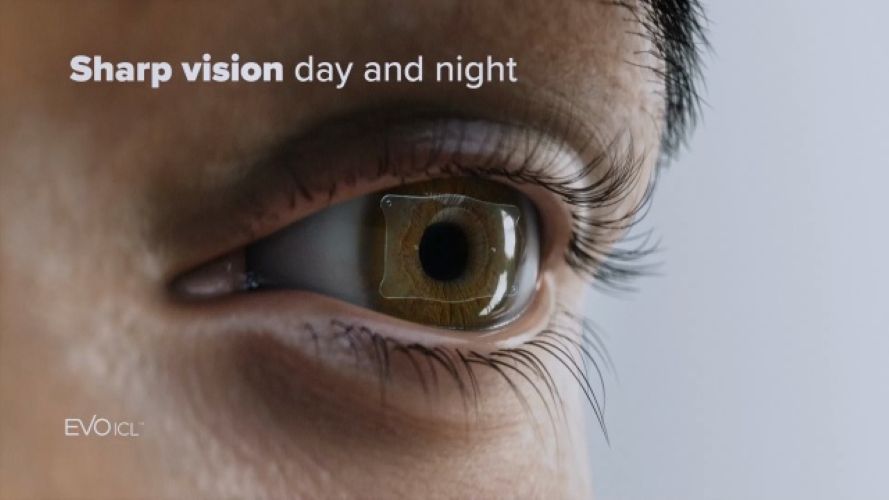
Safety commitment in the Phakic ICL surgical procedure
1. Commitment to Lens Quality
EVO Visian ICL is manufactured by STAAR Surgical, an ophthalmic company headquartered in California (United States), with a production system that meets the strict quality control standards of the U.S. FDA, European CE Mark, and many other international medical regulatory authorities.
Before release, each lens must undergo a multi-layer inspection process for refractive power, geometric precision, optical surface quality, sterility, and structural integrity. The lens is stored in sterile BSS solution throughout the surgical process.
2. Commitment to Structural Integrity
Phakic ICL surgery is committed to preserving the anatomical structure of the cornea. No action is performed to thin or ablate any stromal layers of the cornea.
The microsurgical incision at the corneal limbus is only approximately 2.2 mm in size and is capable of self-sealing through natural intraocular pressure without sutures, minimizing the risk of surgically induced secondary astigmatism.
3. Safety in Measurement and Lens Sizing
STAAR Surgical emphasizes that EVO ICL power and size calculations must be performed using the dedicated STAAR OCOS Calculation Software. Incorrect sizing may lead to an undesired refractive outcome.
Therefore, the preoperative stage is the decisive factor in controlling the risk of intraocular compression. Patients must undergo a comprehensive examination system using modern imaging technologies such as Pentacam, Corvis ST, anterior segment OCT, or UBM (Ultrasound Biomicroscopy) instead of relying solely on the traditional White-to-White measurement:
- UBM ultrasound or anterior segment OCT: Helps doctors accurately measure the structure of the ciliary sulcus or the sulcus-to-sulcus distance measurement system. This data helps accurately calculate the size (Sizing) of the lens.
- Endothelial Cell Density (ECD): Checking that endothelial cell density meets the age-appropriate safety threshold to ensure that the lens does not compromise the survival of this cell layer over time.
Based on digitized anatomical parameters, each EVO ICL lens is uniquely customized for each eye of the patient at STAAR Surgical’s specialized manufacturing facility in Switzerland, ensuring maximum mechanical compatibility when implanted into the body.
Medical Contraindications to Ensure Safety
An inseparable concept of the ophthalmic safety philosophy is strict adherence to patient selection criteria as well as standardized operating procedures by the surgeon.
Manufacturer’s Warnings During Surgery
STAAR Surgical recommends that the surgical procedure follow strict control principles:
- Surgery should only be performed by doctors who have received specialized training in Phakic ICL implantation techniques.
- Always check the correct lens model and power before surgery; reconfirm the optical parameters after opening the package.
- Handle the lens only by the haptic portion, and absolutely do not use forceps to directly touch the central optical zone.
- After lens placement, the ophthalmic viscoelastic material must be completely removed from the eye to reduce the risk of postoperative intraocular pressure elevation.
Patient groups requiring careful evaluation
The safety and effectiveness of EVO ICL have not been fully established in certain special patient groups, requiring specialist doctors to conduct a thorough evaluation before indication:
- Unstable refractive error or history of previous ocular surgery (including corneal refractive surgery).
- Patients with a history of uveitis, iritis, or synechia.
- Individuals with pigment dispersion syndrome or pseudoexfoliation syndrome.
- Patients with insulin-dependent diabetes or diabetic retinopathy.
Absolute Contraindication Criteria (According to STAAR Surgical)
According to the manufacturer’s official instructions, EVO Visian ICL is not indicated in the following cases:
- Insufficient anterior chamber depth: The distance measured from the posterior corneal surface (corneal endothelium) to the anterior surface of the natural crystalline lens (Anterior Chamber Depth – ACD) is less than 3.0 mm.
- Corneal abnormalities or low endothelial cell density: Corneal endothelial cell density is below the safe level, the patient has Fuchs’ Dystrophy, or other corneal diseases affecting corneal function.
- Ocular hypertension or glaucoma: The patient currently has elevated intraocular pressure in one or both eyes; or has primary open-angle glaucoma, angle-closure/narrow-angle glaucoma.
- Narrow anterior chamber angle: Cases with an anterior chamber angle smaller than Grade III according to gonioscopic classification.
- Cataract: Presence of cataract in the eye scheduled for surgery or non-traumatic cataract in the fellow eye.
- Under 21 years old: This age group is not indicated because the refractive error may not yet be fully stable.
- Pregnant or breastfeeding women: Hormonal changes during this period may affect refractive error and the recovery process.
- Ocular disease limiting visual recovery potential: Lesions that prevent postoperative visual acuity from reaching at least 0.477 logMAR (equivalent to approximately 20/60 on the Snellen scale).
- Amblyopia or loss of vision in the fellow eye: Cases with amblyopia or functional blindness in the opposite eye.
- Keratoconus: Cases of keratoconus that are progressing or have not been fully stabilized.
Postoperative Follow-up
STAAR Surgical notes that the long-term effects of the lens need to continue being monitored. Patients must comply with scheduled follow-up visits to comprehensively check the following parameters: Visual acuity, intraocular pressure, lens vault, condition of the natural crystalline lens, and corneal endothelial cell density.
In a small number of abnormal cases, patients may need to undergo additional procedures or surgeries such as lens repositioning, lens replacement or removal, iridotomy/iridectomy to manage pupillary block, wound suturing if leakage occurs, or more advanced interventions such as retinal detachment repair or corneal transplantation.
These warnings and strict protocols do not mean that EVO Visian ICL is an unsafe procedure. On the contrary, they reflect the highest level of quality control process of a premium medical device approved by strict regulatory authorities such as the U.S. FDA.

 24/11/2026












 0916.741.763
 Appointment
