

 vi
vi 10-Jun-2026
 80,750
 Overview of Phakic Surgery
High myopia, severe astigmatism, or thin corneas are conditions that are often unsuitable for laser vision correction procedures such as Femto LASIK or ReLEx SMILE. In these situations, Phakic IOL (Phakic Intraocular Lens) surgery is considered an effective alternative due to its ability to preserve the cornea and maintain long-term visual quality.
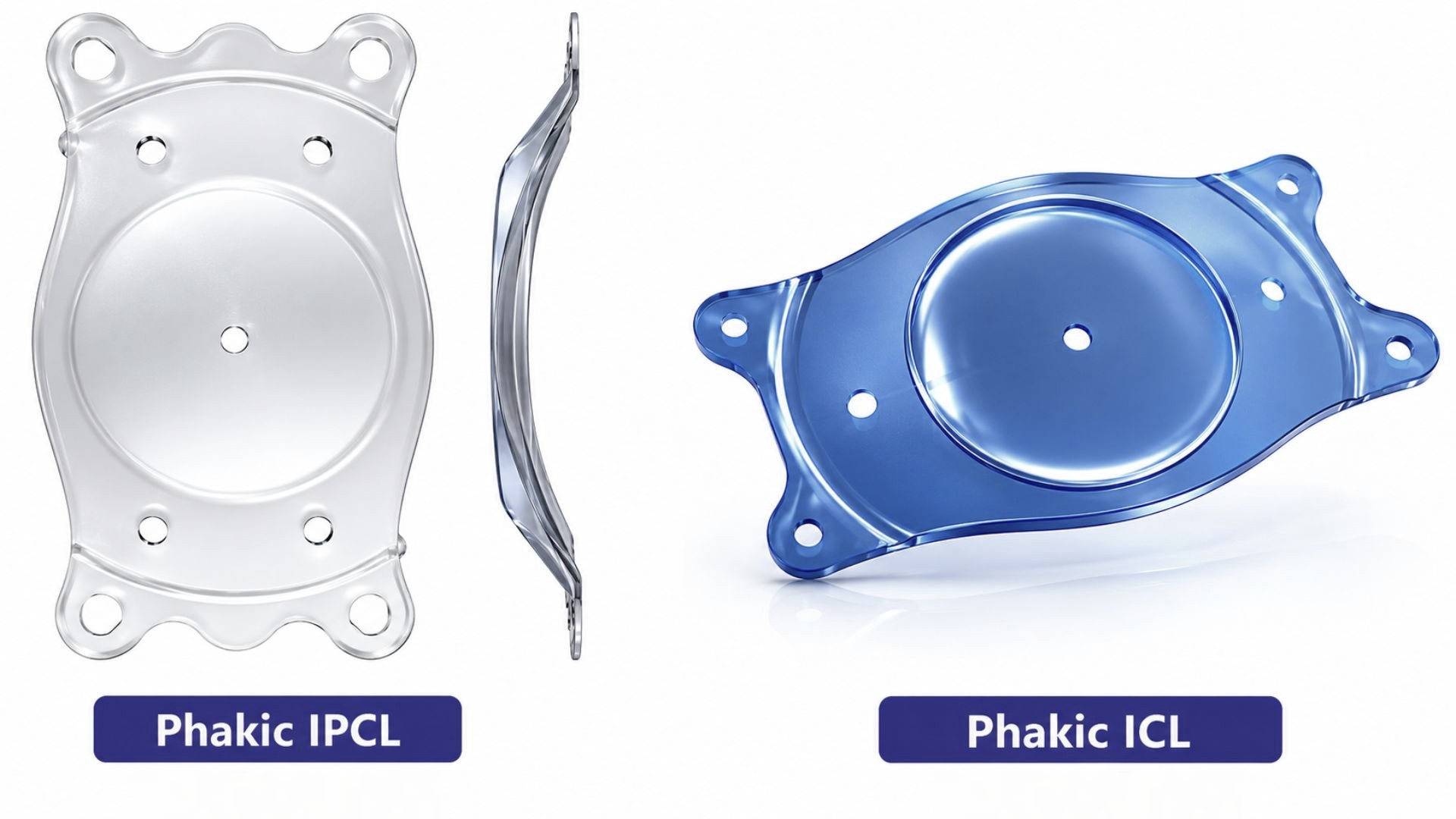
How to distinguish Phakic ICL and IPCL lenses
Today, the two most frequently discussed posterior chamber phakic lenses are EVO Visian ICL (Phakic ICL) from STAAR Surgical (Switzerland/USA) and IPCL V2.0 from Care Group/EyeOL (United Kingdom – India). Although both function based on the principle of implanting a lens behind the iris and in front of the natural crystalline lens, these two products differ significantly in materials, design, treatment range, and clinical data.
EVO Visian ICL Lens (STAAR Surgical)
1. Origin
Researched and developed by STAAR Surgical (California, USA), the latest-generation EVO/EVO+ Visian ICL lens represents the global gold standard and is manufactured at advanced facilities in the United States and Switzerland.
2. Structure and Core Technology
The ICL lens features a plate-haptic design with a convex/concave central optical zone to optimize visual performance.

EVO Visian ICL Lens (STAAR Surgical) (Phakic ICL)
The most significant breakthrough of the EVO ICL generation is the KS-AquaPort® technology – an ultra-small central port measuring 0.36 mm in diameter. This port, combined with four auxiliary flow ports (a total of five ports), allows natural aqueous humor circulation from the posterior chamber to the anterior chamber without requiring preoperative laser peripheral iridotomy, while also minimizing the risk of idiopathic intraocular pressure elevation.
3. Proprietary Collamer® Material
This is the most valuable feature of this lens line. Collamer® is a hydrophilic material composed of advanced biocompatible polymers and coated externally with a layer of pure collagen.
Because its structure closely resembles the eye’s natural tissues, the body does not recognize the lens as a foreign object, virtually eliminating the risk of rejection or chronic inflammatory reactions. Collamer material provides exceptional optical clarity and incorporates a UV-filtering layer that helps protect the retina from harmful ultraviolet radiation.
IPCL Lens (EyeOL UK)
1. Origin
First introduced in 2007 by AddVision (later EyeOL, United Kingdom), the IPCL (Implantable Phakic Contact Lens) represents the deeply personalized philosophy of British medicine, offering an economically efficient solution with an expanded treatment range.
2. Structure and Flow Port Technology
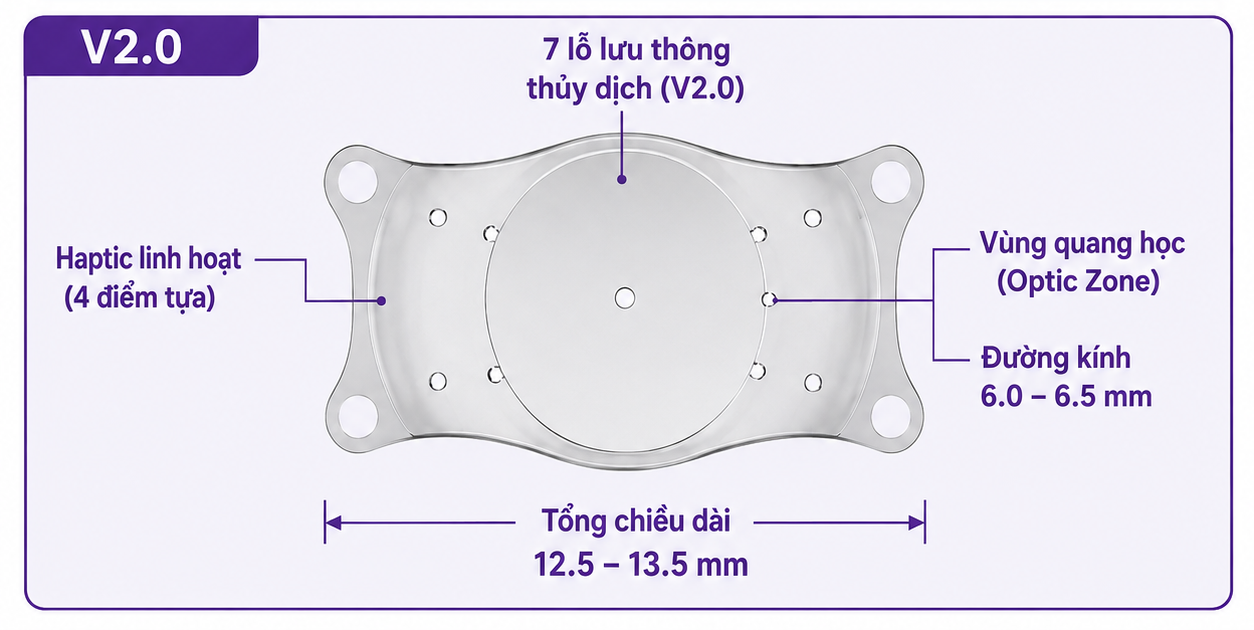
Phakic IPCL Lens (EyeOL UK)
Unlike the ICL, the IPCL lens (particularly the enhanced V2.0 generation) features an aqueous humor circulation system with up to 7 ports. This design includes a uniquely conical-shaped central port with an inner diameter of 420 μm and an outer diameter of 380 μm to optimize fluid dynamics and minimize light scattering, halos, or glare.
In addition, the lens incorporates two ports at the upper edge of the optical zone and four ports located at the optical-haptic transition points.
3. Material and Ideal Thinness
The IPCL is manufactured from Hydrophilic Acrylic Copolymer (26% water content), a material with a high refractive index (1.465) and an Abbe number of 60, delivering sharp optical performance.
A major advantage of this advanced acrylic material is its remarkable thinness: the central thickness of a myopic IPCL lens is only less than 80 microns (approximately 30% thinner than ICL), helping to minimize edge effects and making it particularly suitable for smaller ocular anatomies.
Comparison of specifications, distinguishing characteristics, and assessment of clinical advantages
Below is a summary table of technical specifications and distinguishing characteristics between the two lens lines based on research reports from the FDA and international medical libraries (PubMed/PMC):
| Comparison Criteria | EVO Visian ICL Lens (STAAR Surgical) | IPCL V2.0 Lens (EyeOL UK) |
|---|---|---|
| Origin / Country of origin | USA / Switzerland | United Kingdom |
| Lens material | Proprietary Collamer® (Polymer + Natural Collagen) | Hydrophilic Acrylic Copolymer (26% water) |
| Maximum treatment range | Myopia: -3.0 to -20.0 DHyperopia: up to +10.0 DAstigmatism: up to 6.0 D | Myopia: up to -30.0 DHyperopia: up to +15.0 DAstigmatism: up to 10.0 D |
| Flow port system | 5 ports (1 central KS-AquaPort® 0.36 mm) | 7 ports (1 conical central port 380-420 μm, 2 upper peripheral ports, 4 haptic corner ports) |
| Haptic design | Characteristic C-shaped design, with 4 fixed sizes (12.1mm to 13.7mm) | Multi-point spring design (6 contact points with the sulcus), with up to 13 fixed sizes and deep customization |
| UV protection capability | Integrated UV-filtering layer | No specialized UV-filtering layer integrated |
| Lens thickness | Average thickness of over 100 microns | Ultra-thin, central thickness under 80 microns |
| Identifying characteristics (For doctors) | Transparent, with a bluish-violet reflection under specialized slit-lamp illumination | Transparent, with softer light reflection thanks to the specific Acrylic material |
| Visual outcomes (Clinical) | 81% achieved ≥ 20/40; 41% achieved ≥ 20/20 (FDA study after 3 years) | 66% achieved ≥ 20/40; 45% achieved ≥ 20/20 (According to clinical follow-up data) |
Which Type Has More Advantages?
1. Outstanding advantages of EVO Visian ICL:
The lens from the United States has an absolute advantage in terms of clinical evidence (Evidence-based medicine) and global credibility. Biological Collamer material provides maximum comfort, protects the eyes from UV rays, and minimizes the long-term rate of corneal endothelial cell loss. In addition, FDA data serve as the strongest guarantee of ICL safety.
2. Outstanding advantages of IPCL:
The lens from the United Kingdom wins in terms of breakthrough refractive range and geometric customization. IPCL can manage “ultra-high” myopia/astigmatism cases that exceed the capability of ICL. Thanks to its multi-point compression spring haptic design and thickness under 80 microns, IPCL helps doctors size the lens accurately and control vault height effectively, even in patients with narrow ocular structures (shallow anterior chamber) – a common contraindication for ICL.
Furthermore, IPCL features “Smart Toric” technology (pre-molded astigmatism axis on the 0-180° axis), allowing the lens not to require intraocular rotation during surgery and minimizing the risk of postoperative lens axis misalignment.
User groups
Phakic surgery is not based solely on the degree of myopia, but rather on the combination of biological, occupational, and psychological factors of the patient.
1. For users of the EVO Visian ICL lens
- Ocular characteristics: The anterior chamber depth (ACD) must ideally be 3.00 mm or greater (measured from the corneal endothelium to the anterior surface of the crystalline lens). The endothelial cell count must meet age-appropriate safety standards. The refractive error should fall within approximately 20 diopters of myopia and 6 diopters of astigmatism.
- Age: Most suitable from 18 to 45 years old (the age when the body has fully developed and the refractive error is stable, with no change greater than 0.75 diopters within 6 months).
- Occupation and lifestyle: Extremely suitable for people with high physical activity levels such as professional athletes, fitness trainers, military personnel, pilots, or those who frequently move outdoors (thanks to the UV protection feature that helps protect the retina).
2. For users of the IPCL lens
- Ocular characteristics: Individuals with small ocular anatomy and a narrow anterior chamber (borderline ACD values below 3.00 mm but still within the safe range for intervention) or narrow anterior chamber angles. In particular, cases with “beyond-threshold” myopia/astigmatism (for example: -22.00 D myopia, 8.00 D astigmatism) must choose IPCL because ICL does not manufacture solutions for this refractive range.
- Age: From 18 years and older for single-vision myopia/astigmatism lens models. However, EyeOL has also developed the IPCL Presbyopic (Multifocal) lens line, expanding the treatment segment for individuals aged 40 to 60 years who are beginning to experience signs of presbyopia, allowing them to see clearly at all three distances (far, intermediate, and near) without the need for reading glasses.
- Occupation and Lifestyle: Office workers, programmers, graphic designers, and individuals who require sharp visual quality at near and intermediate working distances (particularly for the multifocal lens line).
Are You More Suitable for EVO Visian ICL or Phakic IPCL?
| If you… | Recommended Option |
|---|---|
| Want the most extensively researched technology in the world | EVO Visian ICL |
| Are looking for a lens made from premium biocompatible material with UV protection | EVO Visian ICL |
| Prioritize long-term safety | EVO Visian ICL |
| Have thin corneas or dry eyes | EVO Visian ICL |
| Have extremely high myopia above 20 diopters | Phakic IPCL |
| Have very high astigmatism (or presbyopia) | Phakic IPCL |
| Want to optimize costs | Phakic IPCL |
| Need a highly customized lens | Phakic IPCL |
Both EVO ICL and IPCL V2.0 are advanced refractive correction solutions designed for individuals with high myopia, thin corneas, or those who are not suitable candidates for laser vision correction procedures. However, in terms of global adoption, long-term scientific evidence, and clinical reliability, EVO ICL is still considered the benchmark standard among posterior chamber phakic lenses. Meanwhile, IPCL stands out for its broader treatment range, higher degree of customization, and more accessible cost.
Subjective assessments can never replace a comprehensive diagnostic evaluation using modern ophthalmic imaging systems. Discuss thoroughly with an experienced ophthalmologist to find the lens that is truly designed for your unique eyes.

 01/10/2026









 0916.741.763
 Appointment