

 vi
 07-Jun-2026
 41,230
Overview of Night Vision Disturbances
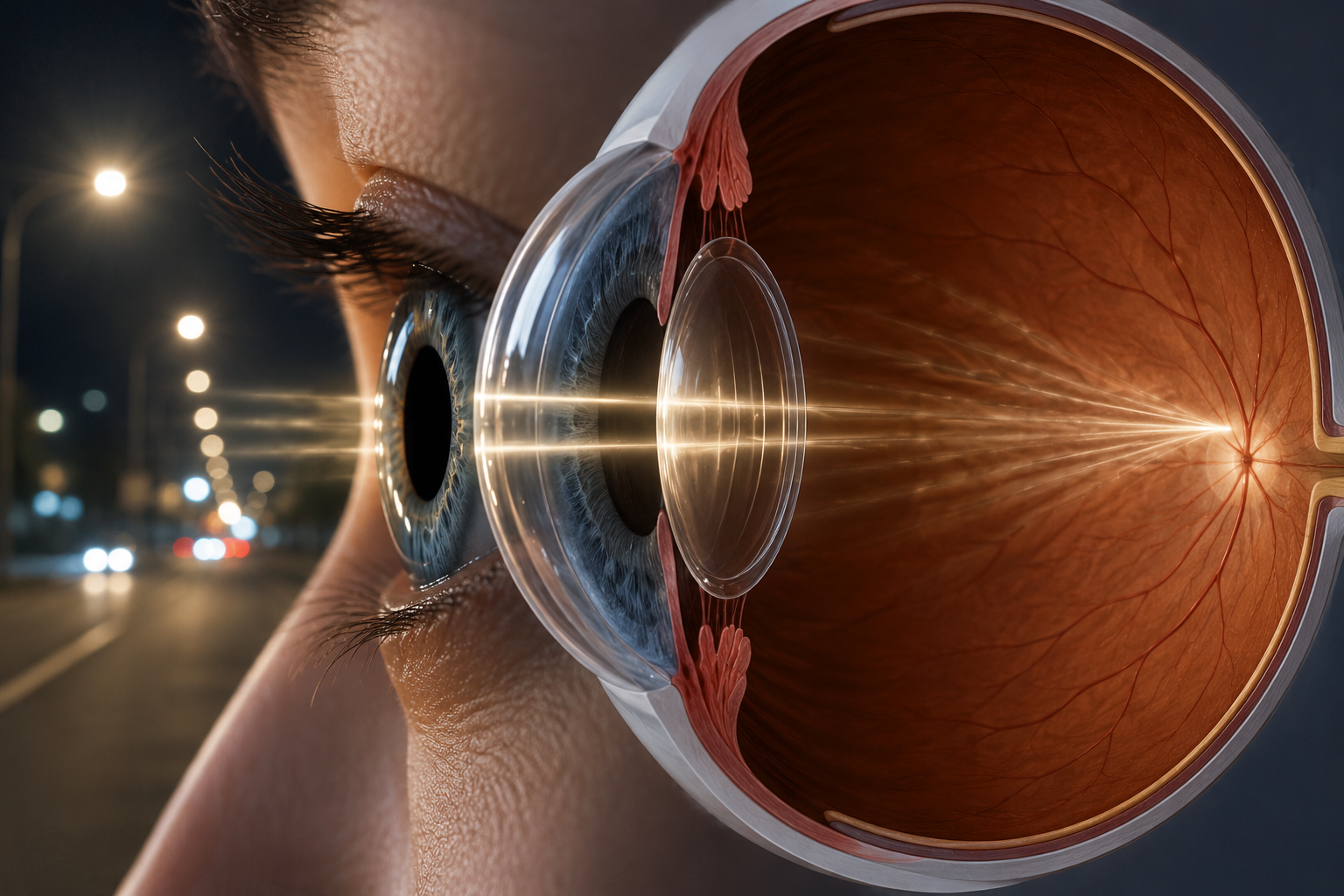
Illustration of the mechanism behind night halos and light scattering within the eye
To understand why these visual phenomena occur, it is important to examine how the eye adapts to darkness. When ambient light decreases, the pupil (the dark center of the eye) dilates to allow as much light as possible to enter.
However, when the pupil enlarges, light rays pass through the peripheral regions of both the cornea and the crystalline lens. If these structures have subtle irregularities in shape or transparency, light is scattered rather than focused precisely onto a single point on the retina. In ophthalmology, this phenomenon is known as Higher-Order Aberrations (HOAs).
Night Halos
Night halos refer to the appearance of one or more rings of light surrounding light sources such as streetlights, vehicle headlights, or LED lights.
This occurs because light is not focused accurately on the retina but is instead scattered or refracted abnormally as it passes through the eye’s optical structures.
Patients commonly describe:
- Seeing circular rings of light around lamps or headlights.
- Halos becoming more noticeable in dark environments.
- Difficulty judging the distance of objects at night.
Glare
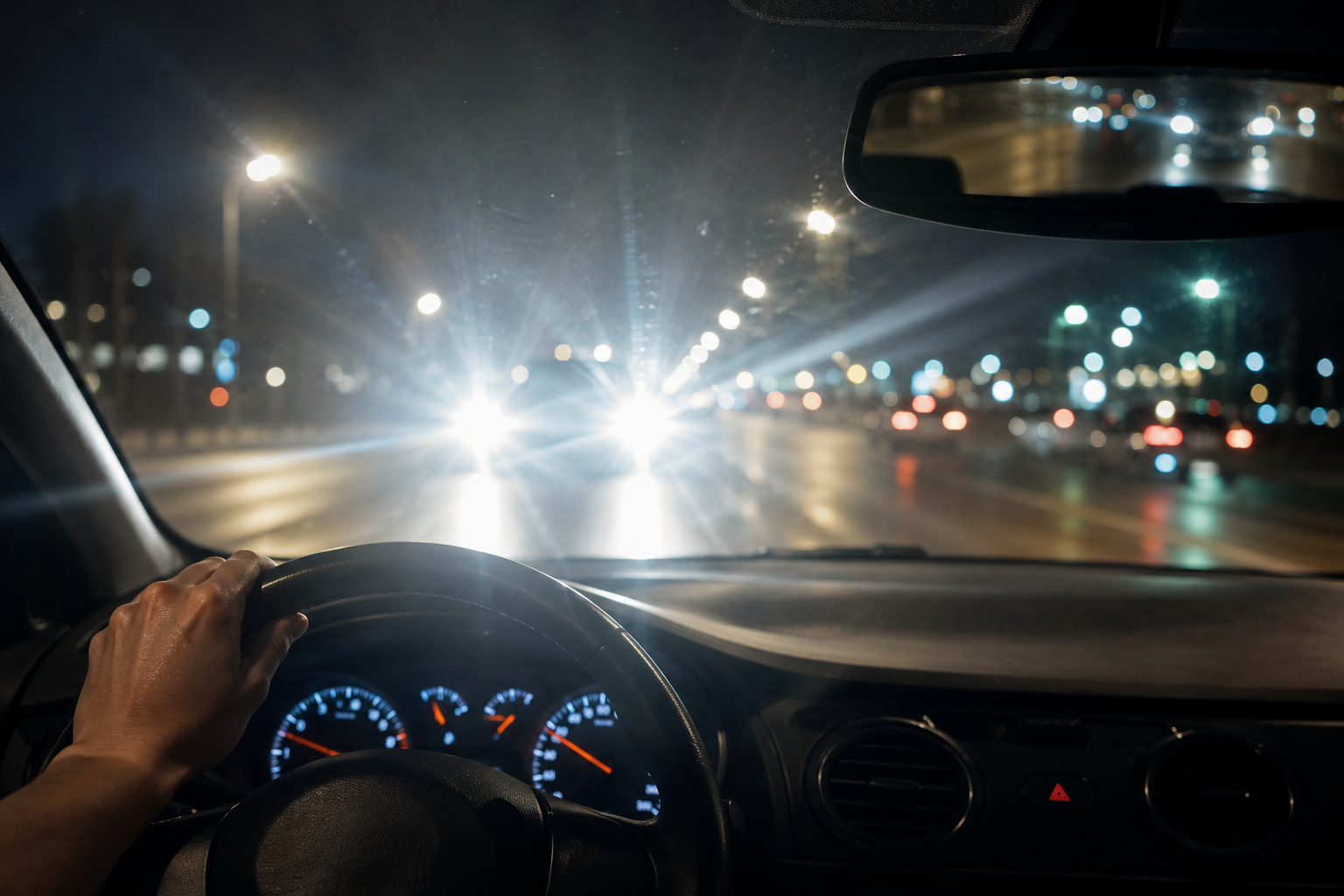
Glare while driving at night caused by oncoming headlights reducing visibility
Glare is the sensation of visual discomfort when the eyes are exposed to a bright light source. Unlike halos, patients do not necessarily see rings around lights; instead, the light appears excessively intense and interferes with clear vision.
Common examples include:
- Difficulty seeing when facing oncoming vehicle headlights.
- Difficulty reading road signs under bright illumination.
- A constant need to squint.
Dazzle
Dazzle is a more severe form of glare. In this situation, intense light significantly reduces visual performance or causes a temporary inability to recognize images.
Patients may experience:
- Inability to clearly see objects ahead for several seconds.
- Loss of visual adaptation immediately after encountering a bright light source.
- Increased risk when driving at night.
Table 1. Comparison of Night Halos, Glare, and Dazzle
| Criteria | Night Halos | Glare | Dazzle |
|---|---|---|---|
| Characteristics | Rings around light sources | Discomfort caused by bright light | Reduced vision due to intense light |
| Perception | Visible rings of light | Need to squint | Temporary loss of visual awareness |
| Severity | Mild to moderate | Moderate | More severe |
| Typically Occurs | At night | Bright environments | Headlights or high-intensity light sources |
| Driving Risk | Present | High | Very high |
Causes and Risk Factors
Night vision disturbances and halos do not occur spontaneously. They are the result of multiple factors ranging from lifestyle habits and natural eye conditions to postoperative complications.

Glare while driving at night under high-intensity headlights
Common Causes
Uncorrected or Poorly Corrected Refractive Errors
Myopia, hyperopia, and especially astigmatism (when the cornea is not evenly curved) are among the leading causes. If you wear an incorrect prescription or do not wear glasses while driving at night, halos and dazzle may become much more noticeable because the retina receives a blurred image.
Cataracts
According to the U.S. National Eye Institute (NEI), cataracts are a classic cause of halos and glare. As lens proteins gradually clump together with age, the lens becomes cloudy rather than transparent, causing incoming light to scatter unpredictably.
Severe Dry Eye Disease
A stable tear film acts as the eye’s first smooth optical surface. When the eye becomes dry, the corneal surface becomes irregular, leading to glare and dazzle when exposed to bright light.
Risk Factors and High-Risk Groups
- Individuals over 50 years old who experience natural aging of the crystalline lens and reduced tear film quality.
- Patients who previously underwent older-generation laser refractive surgery, which may alter peripheral corneal geometry and increase optical aberrations when the pupil dilates at night.
- People with diabetes, as chronically elevated blood sugar levels can alter lens transparency and osmotic balance, resulting in temporary or persistent halos.
Signs and Symptoms
Night vision disturbances and halos may develop gradually or appear suddenly. Below are some common clinical manifestations.
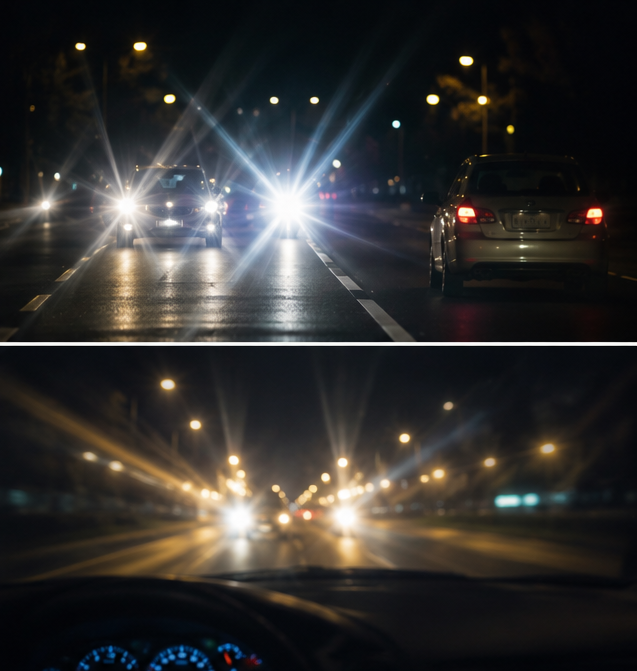
Symptoms of night vision disturbances and halos affecting driving visibility
Early and Typical Symptoms
- Eye fatigue and headaches after driving at night or working in low-light environments.
- Frequent squinting to read traffic signs because letters appear blurred with ghost images around them.
- Seeing elongated streaks of light from oncoming headlights, temporarily obscuring the road ahead.
- Difficulty distinguishing low-contrast objects, such as pedestrians wearing dark clothing in shaded areas.
Danger Signs That Require Immediate Eye Examination
- The appearance of halos accompanied by severe eye pain, redness, and headache on one side (possible signs of an acute glaucoma attack caused by elevated intraocular pressure).
- Halos or dazzle occurring together with flashes of light or a moving curtain-like shadow across the visual field (possible signs of a retinal tear or retinal detachment).
- Sudden and significant vision loss developing over a few days or weeks.
Advanced Diagnostic Methods at Eye Clinics
To accurately identify the cause of halos, glare, and dazzle, ophthalmologists do more than perform standard vision tests. Advanced ocular imaging technologies are often required.
Corneal Topography:
This technology scans the entire corneal surface and creates a detailed three-dimensional map. It helps ophthalmologists detect abnormal corneal elevations, keratoconus, and microscopic corneal scars that may contribute to glare and visual disturbances.
Wavefront Aberrometry:
This advanced technology measures how light travels through the entire optical system of the eye. It generates a map of higher-order aberrations, which are among the primary causes of nighttime starbursts and visual disturbances.
Slit-Lamp Examination:
Using a specialized light source and microscope, ophthalmologists evaluate corneal clarity, tear film quality, and the degree of lens opacity.
Treatment Options and Emerging Technologies
Night halos are not a disease themselves but rather a visual symptom. Therefore, treatment depends on the underlying cause.
Table 2. Treatment of Night Halos Based on the Underlying Cause
| Cause | Treatment Approach |
|---|---|
| Dry Eye Disease | Artificial tears, eyelid inflammation treatment, and improvement of tear film quality |
| Uncorrected Astigmatism | Accurate prescription glasses or properly fitted contact lenses |
| Keratoconus | Rigid gas permeable lenses, scleral lenses, and Corneal Cross-Linking (CXL) |
| Cataracts | Cataract surgery with intraocular lens implantation |
| Higher-Order Aberrations | Customized eyewear, refractive correction, and wavefront-guided treatment in selected cases |
| Post-Refractive Surgery Effects | Visual adaptation monitoring, dry eye management, and aberration assessment if symptoms persist |
| Large Pupils at Night | Pupil-constricting medications (when prescribed by an ophthalmologist) or selecting an appropriate refractive procedure from the outset |
Medical and Lifestyle-Based Management
- Night-Optimized Eyewear: Glasses with high-quality anti-reflective coatings can reduce unwanted light reflections and improve nighttime visual comfort.
- Tear Film Management: Using appropriately formulated artificial tears before night driving can smooth the corneal surface and improve optical quality.
When the Cause Is High Myopia or Astigmatism
For patients with refractive errors such as high myopia or astigmatism who seek a long-term solution without increasing the risk of nighttime glare after laser vision correction, Phakic ICL (Implantable Collamer Lens) is currently regarded by many international experts as one of the most effective options.
What is Phakic ICL? It is a procedure in which a thin biocompatible lens is implanted inside the eye, positioned behind the iris and in front of the natural crystalline lens. This technique does not remove corneal tissue or alter the natural shape of the cornea.
Today, Phakic ICL is highly regarded for its ability to maintain excellent visual quality under low-light conditions because it:
- Provides a large optical zone.
- Does not alter the shape, structure, or natural biomechanical curvature of the cornea.
- Minimizes the induction of additional higher-order aberrations.
- Maintains better contrast sensitivity in low-light environments.
- Suitable for individuals with high myopia or thin corneas who are not ideal candidates for laser vision correction.
How to Protect and Maintain Healthy Night Vision
To keep your eyes healthy and reduce light scattering phenomena, ophthalmologists recommend adopting the following habits:
- Consume foods rich in lutein, zeaxanthin, and vitamins A, C, and E, such as kale, spinach, carrots, and salmon. These nutrients help maintain lens transparency and support retinal health.
- Clean your eyeglasses and vehicle windshield using appropriate cleaning materials before driving at night.
- Limit exposure to blue light before bedtime by avoiding electronic devices for at least one hour before sleep, allowing the eyes to fully rest in darkness.
Although they are often confused with one another, night halos, glare, and dazzle are three distinct visual phenomena. Correctly recognizing these symptoms can help identify underlying eye conditions such as keratoconus, dry eye disease, cataracts, or optical abnormalities at an early stage.
As diagnostic and treatment technologies continue to advance, early eye examinations play a crucial role in determining the exact cause and selecting the most appropriate management strategy to preserve visual quality, particularly in low-light conditions and during nighttime driving.

 24/11/2026













 0916.741.763
 Appointment
