

 vi
vi 14-Oct-2026
 380
380 Retinitis pigmentosa is a rare inherited eye disease, with a prevalence of about 0.02-0.03% in the general population. The disease progresses silently over many years, gradually reducing vision and potentially leading to blindness. Although there is currently no definitive cure, early detection and proper monitoring can help slow the progression of the disease and preserve vision for longer.
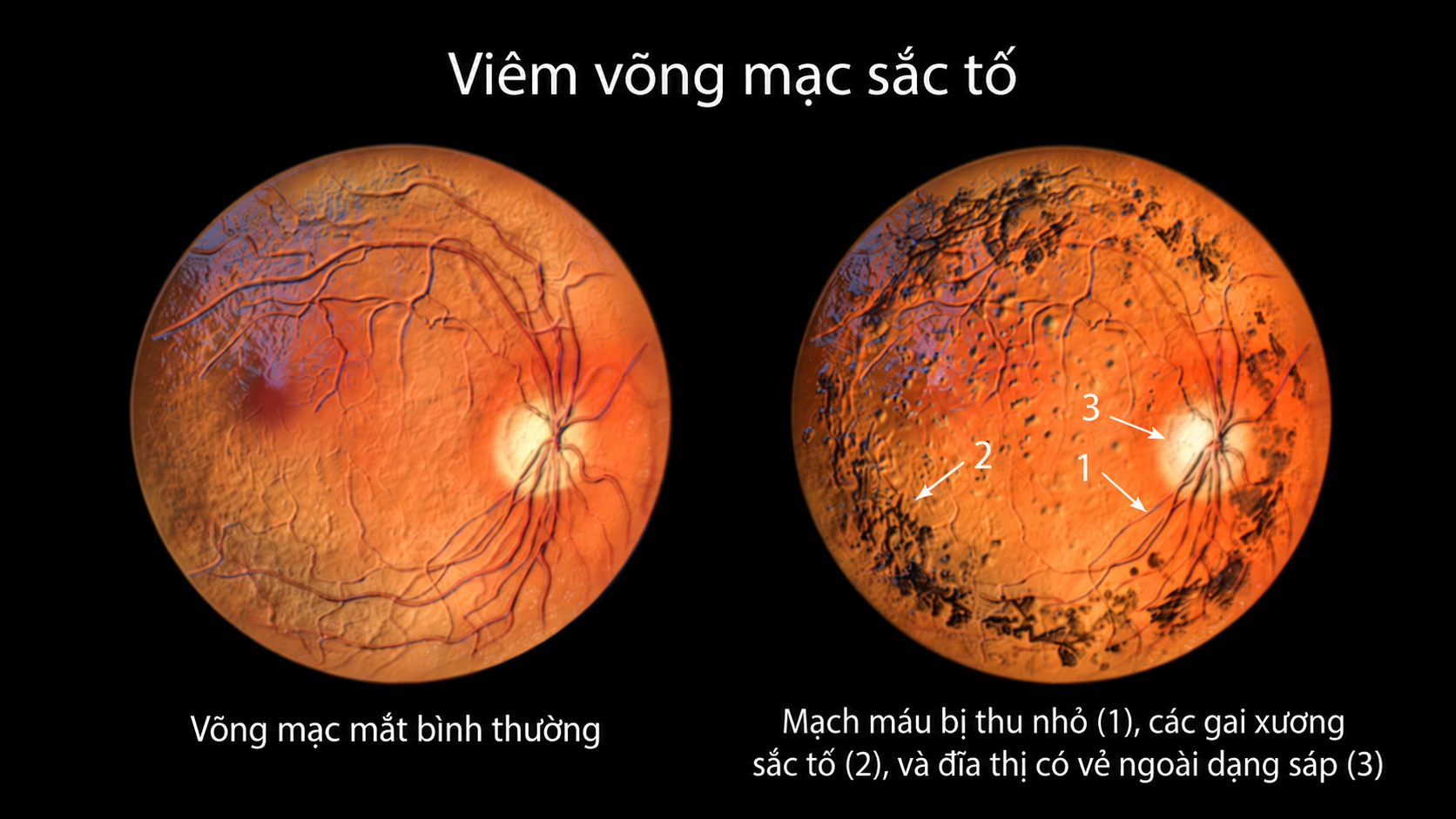
Normal eye and eye with retinitis pigmentosa
What is retinitis pigmentosa?
The retina is the innermost layer of the eyeball, made up of several layers of cells, including the layer of visual nerve cells, the pigment epithelium and the choroid. The retina contains two special types of light-sensitive cells, the rods and the cones, which receive light and transmit images to the brain.
- Rods: highly sensitive to light, allowing us to see objects in low-light conditions and helping to widen the field of vision.
- Cones: require more light, help us recognize fine details, focus vision on a single point and distinguish colors. These cells are concentrated in the central part of the retina and determine the sharpness of vision.
Retinitis pigmentosa (also known as night blindness) is a group of diseases that affect the retina. The disease typically destroys the rods first, causing vision to gradually deteriorate and eventually leading to blindness. Degeneration of the retinal pigment epithelium can appear from birth or at a later stage. As the rods degenerate, the visual field progressively narrows. The cones then degenerate as well, resulting in severe vision loss.
Causes of retinitis pigmentosa
The exact cause of the disease is still unclear. However, experts believe that most cases are related to genetic abnormalities. The extent of the mutation and the pattern of inheritance determine the severity and the speed of progression in each person.
Gene mutations can be inherited from the father, the mother or both. Among these:
- Recessive inheritance accounts for about 60-70%.
- Dominant inheritance accounts for about 25%.
- The remainder is X-linked inheritance.
If a parent has the disease, the child’s risk of developing it is higher.
Symptoms of retinitis pigmentosa
Symptoms usually first appear in childhood. At first the signs are mild, and more severe signs tend to become evident in adulthood. Common symptoms include:
- Reduced vision at night or in poorly lit places.
- Narrowed visual field and loss of peripheral vision: patients feel as if they are looking through a tunnel (tunnel vision) and are prone to tripping and falling.
- Loss of central vision in some patients; in severe cases, both central and peripheral vision may be lost.

Symptoms of retinitis pigmentosa
The disease develops differently in each person, and its manifestations change from stage to stage:
- Mild stage: patients have difficulty seeing in low light, gradually lose peripheral vision, and notice that colors look darker and paler.
- Severe stage: night vision is completely lost, and both peripheral and central vision are lost (objects at the edges and in the center cannot be seen clearly). Patients cannot tell colors apart and see only black and white; in the most advanced cases, they cannot see at all.
Treatment of retinitis pigmentosa
There is currently no therapy proven to cure the disease. However, some measures can help slow its progression and support patients in daily life:
- Vitamin A supplementation: studies suggest that an appropriate dose of vitamin A can slow the progression of the disease, delaying blindness by up to 10 years in some patients at certain stages. However, supplementation must be guided and prescribed by a doctor.
- Assistive devices: magnifying glasses and infrared night binoculars help patients see better, especially those with tunnel vision or significantly reduced vision in low light.
- Wearing sunglasses during the day: helps protect the retina from ultraviolet rays, contributing to the preservation of vision.
- Regular check-ups: help accurately assess the condition, choose appropriate management, and detect and treat accompanying conditions early, such as refractive errors, cataracts and glaucoma.
In addition, scientists have been researching new treatment approaches such as retinal transplantation, artificial retinal implants and gene therapy. These methods have shown some effectiveness but are not yet widely available and are quite costly.
Prevention and slowing disease progression
Because the cause is related to genetic factors, the disease cannot be completely prevented. However, some lifestyle changes can help keep it from progressing more severely:
- Avoid staying up late and using phones or computers in poor lighting, and limit work pressure and psychological stress.
- Limit alcohol, cigarettes and other stimulants.
- Get adequate rest and relaxation, and exercise regularly.
- If a family member has the disease, get examined and screened early to detect the risk.
When detected at an early stage and managed appropriately, the disease progresses more slowly, reducing the risk of early blindness. When abnormal signs are noticed, the family should take the patient to a reputable medical facility for examination and treatment.
Conclusion
Retinitis pigmentosa is a rare inherited disease that progresses slowly but can cause severe vision loss. Although it cannot be completely cured, early detection, regular check-ups and a healthy lifestyle help slow the disease and protect vision in the long term.

 06/10/2026










 0916.741.763
 Appointment