

 vi
vi 25-Apr-2026
 29,545
 In the era of digital transformation, office workers’ eyes are subjected to tremendous strain. On average, senior executives and programmers may spend between 8 and 12 hours each day staring at electronic screens.
As a result, there has been a dramatic increase in eye conditions collectively known in modern medicine as Computer Vision Syndrome (CVS).
Computer Vision Syndrome (CVS)

For office workers who do not wear glasses, the ideal eye exam frequency is once every 12 months
Before determining the ideal frequency for eye exams, it is important to understand why office workers’ eyes are particularly vulnerable.
Computer Vision Syndrome (CVS) is a term used to describe a group of eye and vision problems caused by prolonged use of computers, tablets, and mobile phones.
Unlike reading a printed book, characters displayed on digital screens lack sharp contrast. In addition, high-energy blue light can penetrate deeply into the retina, potentially damaging light-sensitive retinal cells.
According to The Vision Council, approximately 80% of adults who use digital devices for more than two hours per day experience symptoms of CVS. A study published on PubMed also found that office workers are three times more likely to develop dry eye syndrome compared to outdoor workers or those engaged in manual labor.
How Often Should Office Workers Have an Eye Exam?
The ideal frequency of eye examinations varies from person to person. It depends on age, current refractive status, and any underlying medical conditions.
1. For Individuals with Normal Vision
If you are fortunate enough to have healthy vision and do not wear glasses, the ideal frequency is once every 12 months.
Regular eye exams help detect silent eye conditions early, such as glaucoma and small retinal tears, both of which often develop without noticeable symptoms in their early stages.
2. For Individuals with Refractive Errors (Myopia, Hyperopia, Astigmatism)

People with refractive errors should have an eye exam every 6 to 12 months
This group requires more attentive care. The recommended frequency is every 6 to 12 months.
- Regular examinations help determine whether your current prescription is still appropriate.
- Wearing the wrong prescription is one of the leading causes of rapidly progressing myopia and chronic accommodative eye strain.
3. For Adults Over 40
After the age of 40, the eye’s natural focusing ability gradually declines, leading to presbyopia. According to the American Academy of Ophthalmology (AAO), adults over 40 should have a comprehensive eye exam once a year to screen for age-related conditions such as cataracts and macular degeneration.
4. For Individuals With Underlying Medical Conditions (Diabetes, Hypertension)
If you are an office worker currently being treated for diabetes or high blood pressure, you should follow your ophthalmologist’s personalized examination schedule, typically every 3 to 6 months. These conditions can lead to serious retinal complications that may result in permanent vision loss.
Why Should Office Workers Not Delay Eye Examinations?

Why should office workers not delay eye examinations?
1. Early Detection of Visual Disorders
Research shows that adults who spend more than six hours per day in front of screens have a significantly higher risk of accommodation and binocular vision problems compared to those with less digital device exposure.
Working under artificial lighting and focusing at near distances for prolonged periods can contribute to strabismus or functional amblyopia. Regular eye examinations allow doctors to prescribe visual therapy exercises to restore proper eye muscle function.
2. Optimizing Work Habits and Workspace Ergonomics
A survey by The Vision Council found that 59% of office workers frequently experience headaches, dry eyes, or blurred vision after work. Many position their screens too close (less than 50 cm) or too high relative to eye level, increasing strain on both the focusing muscles and the neck and shoulder muscles.
Experts recommend:
- Keeping the screen approximately 50–70 cm from your eyes
- Positioning the top edge of the monitor 10–15 degrees below eye level
- Adjusting screen brightness to match ambient lighting
Proper adjustments alone can reduce eye strain symptoms by up to 40% within just a few weeks.
3. Screening for Blue Light-Related Complications
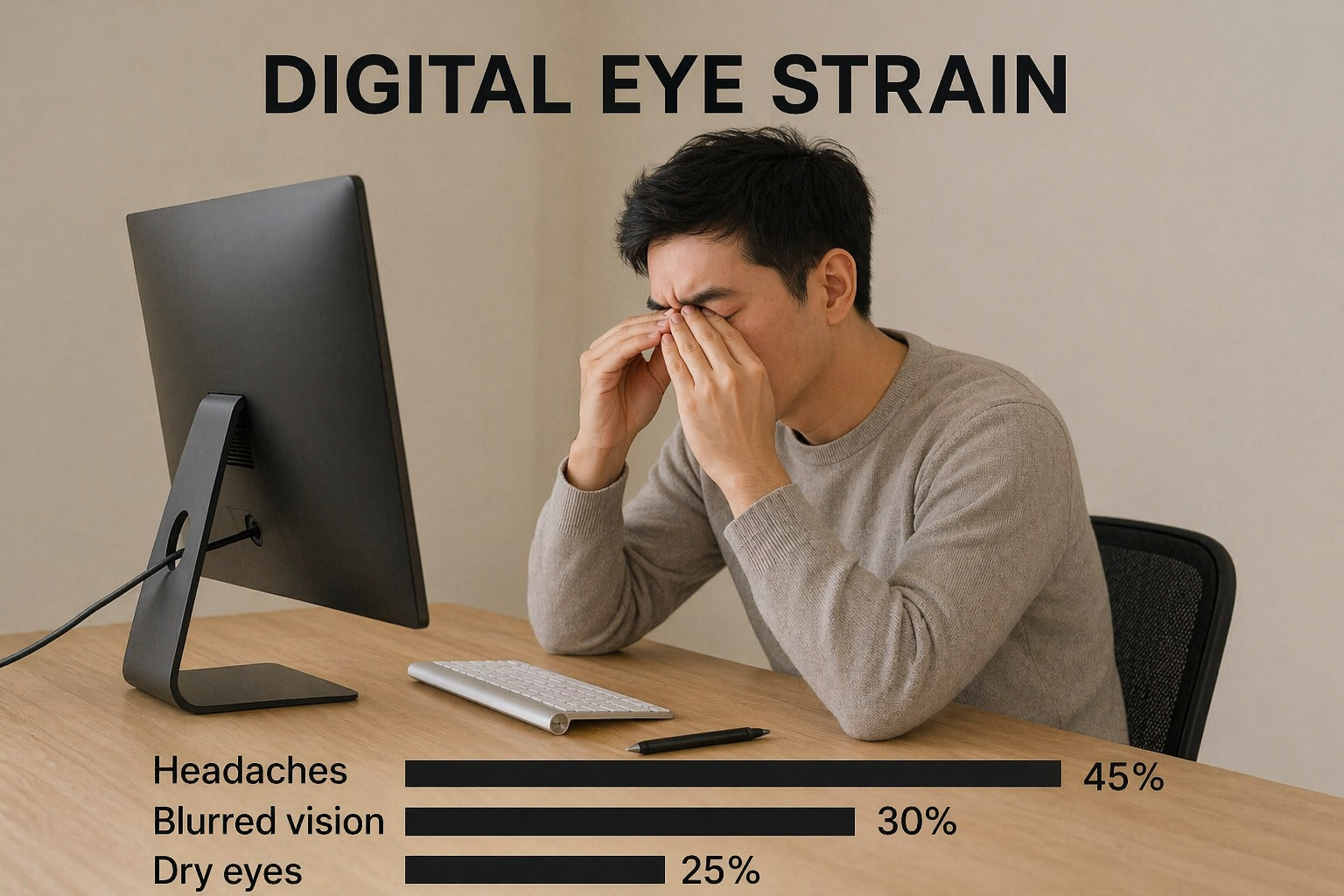
Office workers have a significantly higher prevalence of headaches, blurred vision, and dry eyes
On average, office workers blink only 5–7 times per minute while using screens, nearly half the normal rate of 15–20 blinks per minute. This accelerates tear evaporation and substantially increases the risk of dry eye disease. Research published in Ophthalmic and Physiological Optics reported that:
- 65% of individuals who use computers for more than four hours daily experience dry eye symptoms.
- Those who use screens continuously for over eight hours have nearly twice the risk of developing dry eye.
Additionally, prolonged exposure to high-intensity blue light may increase oxidative stress in the retina, especially in individuals at risk for macular degeneration.
Comprehensive eye examinations help doctors assess tear film quality, corneal surface health, and determine whether artificial tears or specialized lenses are needed.
Warning Signs That Require Immediate Eye Care
Do not wait until your next scheduled appointment if you experience any of the following symptoms:
- Persistent Dry Eyes: A gritty sensation, itching, redness, or burning after several hours of work.
- Headaches and Neck Pain: Often a sign of excessive visual accommodation, placing strain on the nervous system and neck muscles.
- Visual Distortion: Straight lines appear curved, double vision occurs, or blind spots develop in your field of view.
- Flashes or Floaters: Seeing black spots drifting across your vision or sudden flashes of light. These may indicate retinal detachment.
- Extreme Light Sensitivity: Feeling unusually uncomfortable even under normal office lighting.
Comparison Table: Routine Eye Exams vs. Symptom-Driven Visits
| Criteria | Routine Eye Exams (Proactive) | Only When Symptoms Appear (Reactive) |
|---|---|---|
| Recovery Potential | High, often manageable with medical treatment | Lower, may require surgical intervention |
| Cost | Lower, mainly examination and consultation fees | Higher, including complication management and specialized medications |
| Vision Stability | Helps maintain stable prescriptions and prevents rapid progression | Higher risk of rapid refractive changes and amblyopia |
| Work Performance | Improves focus and reduces visual fatigue | Reduced concentration, frequent headaches, and discomfort |
Practical Tips to Protect Your Eyes at Work
To extend the time between necessary medical interventions, office workers should follow these “golden” rules:
- The 20-20-20 Rule: Every 20 minutes, look at an object at least 20 feet (6 meters) away for 20 seconds. This is one of the best ways to relax your focusing muscles.
- Blink Consciously: When concentrating on screens, blink frequency drops by approximately 60%, increasing the risk of dry eyes. Make a habit of blinking more often.
- Adjust Screen Brightness: Your screen brightness should closely match the surrounding environment. Avoid working in dark rooms with overly bright displays.
- Support Eye Health Through Nutrition: Prioritize foods rich in lutein, zeaxanthin, vitamins A and E, and omega-3 fatty acids, such as salmon, dark leafy greens, carrots, and walnuts.
Common Mistakes Office Workers Should Avoid
Mistake 1: Self-Medicating With Corticosteroid Eye Drops
Many people immediately purchase “miracle” eye drops when their eyes become red, expecting instant relief. However, prolonged use of corticosteroid eye drops can lead to glaucoma and steroid-induced cataracts.
Mistake 2: Relying Solely on Vision Tests at Optical Stores
Optical shops typically perform only refraction tests for prescribing glasses. A comprehensive eye examination at a hospital or specialized eye clinic includes retinal evaluation, intraocular pressure measurement, and assessment of binocular vision and eye muscle coordination.
Mistake 3: Believing That Wearing Glasses Will Weaken Your Eyes or Worsen Your Prescription
In reality, not wearing glasses—or wearing an incorrect prescription—is one of the leading causes of eye strain and rapid refractive progression.
Frequently Asked Questions (FAQ)
Question 1: If I already wear blue light blocking glasses, do I still need regular eye exams?
Answer: Yes. Blue light blocking glasses are simply a supportive tool to reduce eye strain. They cannot prevent issues related to intraocular pressure, retinal health, or progressive refractive errors.
Question 2: What does a routine eye exam for office workers typically include?
Answer: A standard comprehensive eye examination usually includes visual acuity testing, automated refraction, eye movement assessment, slit-lamp examination to evaluate the cornea and lens, and a dilated retinal examination to screen for retinal disorders.
Question 3: Why does prolonged computer use often cause headaches?
Answer: This is primarily due to accommodative eye strain. The internal focusing muscles of the eyes must contract continuously to maintain clear vision at near distances. This prolonged tension can radiate through surrounding nerves, causing pain in the forehead and temples.

 01/10/2026











 0916.741.763
 Appointment