

 vi
vi 16-Aug-2026
 19,950
 After 25 years of establishment and development, the Refractive Surgery Department at Ho Chi Minh City Eye Hospital has performed more than 260,000 procedures, built a comprehensive treatment ecosystem, and set the goal of becoming one of ASEAN’s leading ophthalmology centers.
On June 19, Ho Chi Minh City Eye Hospital held a ceremony marking the 25th anniversary of its Refractive Surgery Department and inaugurated its High-Tech Refractive Surgery Center. Held under the theme “A Comprehensive Refractive Surgery Ecosystem,” the event marked a new stage in the hospital’s diagnosis and treatment of refractive errors.

Ho Chi Minh City Eye Hospital held a ceremony marking the 25th anniversary of its Refractive Surgery Department and inaugurated the High-Tech Refractive Surgery Center under the theme “A Comprehensive Refractive Surgery Ecosystem.”
The event not only reviewed the department’s 25-year journey of professional development but also demonstrated the hospital’s commitment to investing in technology, training healthcare professionals, and expanding its facilities. The hospital regards these as important factors in its goal of raising Ho Chi Minh City’s ophthalmology sector to a regional level.
More than 260,000 refractive procedures performed over 25 years
According to Dr. Le Anh Tuan, Director of Ho Chi Minh City Eye Hospital, the Refractive Surgery Department has gradually expanded its scale, adopted new technologies, and developed a highly qualified team of surgeons since its establishment. After 25 years, the department now has 14 refractive surgeons and is recognized as the unit with the largest number of specialists in this field nationwide. The hospital aims to expand the team to more than 20 surgeons within the next three years to meet the growing demand for treatment.

Dr. Le Anh Tuan, Director of Ho Chi Minh City Eye Hospital, speaks at the anniversary ceremony
To date, Ho Chi Minh City Eye Hospital has performed more than 260,000 refractive procedures. The hospital conducts approximately 10,000–13,000 procedures annually, with its highest recorded volume reaching around 18,000 in one year. The large number of procedures reflects the growing demand for refractive correction within the community. It also provides a foundation for the medical team to accumulate experience, refine treatment protocols, and strengthen its ability to manage patients with different refractive characteristics.
Throughout its development, the hospital has been among the early adopters of numerous advanced refractive treatment techniques. The continuous introduction of new methods gives patients more options suited to their degree of myopia and astigmatism, corneal characteristics, ocular structure, and individual visual needs.
Building a comprehensive refractive surgery ecosystem
In addition to the number of procedures performed, an important milestone for Ho Chi Minh City Eye Hospital has been the establishment of a comprehensive refractive surgery ecosystem. This ecosystem covers every stage, including examination and diagnosis, evaluation of ocular structures, treatment selection, surgery, and postoperative monitoring. Data connectivity and digital transformation have also been introduced to support patient management, standardize procedures, and improve professional efficiency.
According to the hospital’s leadership, it is one of the few centers in Southeast Asia and Asia capable of providing a relatively comprehensive and diverse range of modern refractive treatment solutions. Developing an ecosystem-based model means treatment is not centered on a single surgical technique. Instead, patients undergo comprehensive examinations before doctors identify the most suitable solution based on factors such as refractive error, corneal thickness and morphology, ocular surface health, retinal condition, and other relevant anatomical characteristics.
This model is particularly significant because not every person with a refractive error is suitable for the same treatment. Some patients may qualify for corneal laser surgery, while those with high myopia, thin corneas, or eyes that do not meet laser safety requirements need to be evaluated for alternative solutions.
The ability to provide multiple options within one system enables doctors to personalize treatment indications while ensuring continuity across screening, surgery, and postoperative care.
A training and technology transfer center for numerous localities
In addition to providing examinations and surgery, Ho Chi Minh City Eye Hospital plays an important role in training, professional support, and technology transfer for healthcare facilities nationwide.

Inauguration ceremony of the High-Tech Refractive Surgery Center at Ho Chi Minh City Eye Hospital
To date, the hospital has trained 37 doctors from 22 healthcare facilities. These include 14 institutions in Ho Chi Minh City and eight in other provinces and cities, ranging from Hanoi and central Vietnam to the Central Highlands and the Mekong Delta.
Through these training activities, doctors receive updated knowledge concerning screening procedures, treatment indications, and refractive surgery techniques. This is one of the solutions for expanding access to specialized services at the local level and reducing the number of patients required to travel to tertiary hospitals.
Technology transfer also contributes to the standardization of professional practices among healthcare facilities. When lower-level medical teams receive systematic training, routine cases can be managed locally, while complex cases can be identified and referred to specialized centers at the appropriate time.
Combining treatment, training, and technology transfer also reinforces Ho Chi Minh City Eye Hospital’s role as a leading ophthalmology institution in southern Vietnam.
Facilities remain the greatest challenge
According to Dr. Le Anh Tuan, Ho Chi Minh City Eye Hospital has a highly qualified workforce, modern equipment, and the ability to rapidly adopt new techniques. However, limitations in physical infrastructure remain the hospital’s greatest development challenge.
The hospital currently has approximately 15,000 square meters of floor space but must serve between 5,000 and 6,000 patient visits each day. This large patient volume places considerable pressure on reception areas, consultation rooms, waiting spaces, technical systems, and support departments.
This situation affects not only the organization of examination and treatment procedures but also the patient experience. Pressure on the hospital’s infrastructure becomes particularly evident during peak hours.
Ho Chi Minh City has recently allocated approximately 2,000 additional square meters to the hospital from surplus properties made available following administrative restructuring. The additional space has enabled the hospital to expand its waiting areas, reorganize several departments, and improve immediate service conditions.
However, according to the hospital’s leadership, the additional space cannot comprehensively resolve overcrowding or meet the long-term need to develop specialized centers.
Proposal for a new 350-bed ophthalmology facility
In line with the plan to establish Ho Chi Minh City as a specialized medical center in the ASEAN region, Ho Chi Minh City Eye Hospital has developed a strategy extending to 2030. One of its major projects is the construction of a new facility in the former District 6 area, near the Hong Bang–Nguyen Chi Thanh corridor, with a planned capacity of 350 beds.
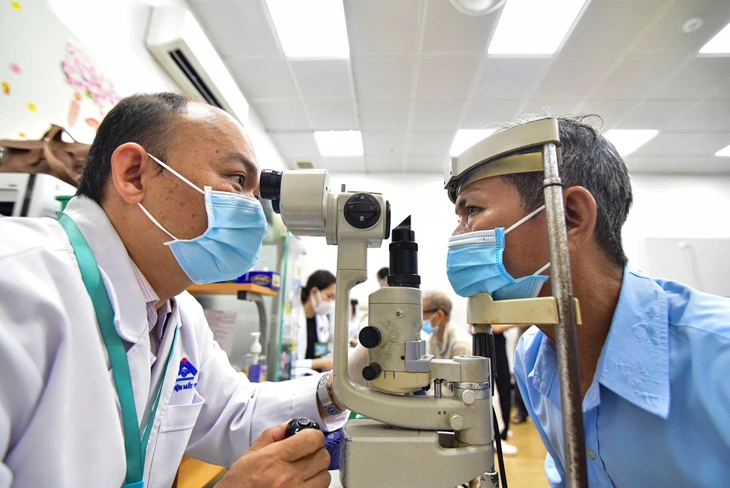
Patients receive examinations and treatment at Ho Chi Minh City Eye Hospital
If implemented, the project will create a modern ophthalmology facility with coordinated investment in space, equipment, and specialized medical centers. It is expected to strengthen the hospital’s treatment, training, and research capacity, enabling it to compete with major ophthalmology institutions across the ASEAN region.
In addition to this project, the hospital plans to build a facility in the Thu Duc area on a site covering approximately 8,000 square meters. The facility is envisioned as a high-quality daytime examination and treatment center focusing on advanced medical services and supporting the development of medical tourism.
The daytime treatment model will allow patients to access specialized techniques without necessarily requiring prolonged hospitalization. Establishing another facility in the eastern part of the city may also help redistribute patient volumes and ease pressure on the hospital’s main campus.
In the former Binh Duong area, the hospital is also proposing the allocation of land to develop an ophthalmology center serving residents throughout southeastern Vietnam. The center is expected to focus on common eye diseases while supporting blindness prevention and community eye care programs.
Continuing its leading role in ophthalmology
Associate Professor Nguyen Anh Dung, Deputy Director of the Ho Chi Minh City Department of Health, said the city’s health sector remained committed to improving the quality of medical examination and treatment, developing specialized healthcare, and establishing Ho Chi Minh City as a regional healthcare center.
Within this broader strategy, Ho Chi Minh City Eye Hospital will continue to play a leading role in ophthalmology. The development of advanced medical techniques must proceed alongside the hospital’s responsibilities for community eye care, blindness prevention, and improving public access to services.
With more than 260,000 refractive procedures performed over 25 years, a team of 14 surgeons, and an increasingly comprehensive treatment ecosystem, the hospital has established a strong foundation in professional expertise and human resources.
In the next stage, coordinated investment, expanded facilities, and the development of specialized ophthalmology services will determine the hospital’s ability to realize its goal of becoming one of the leading eye care centers in the ASEAN region.

 03/10/2026













 0916.741.763
 Appointment