

 vi
vi 03-Mar-2026
 44,555
 What Is Phakic ICL and How Does It Treat Myopia?

What Is Phakic ICL and How Does It Treat Myopia?
In recent years, Phakic ICL (Implantable Collamer Lens) has been considered one of the most advanced refractive error treatment methods, especially suitable for people with high myopia, thin corneas, or those who are not eligible for laser surgery.
Phakic ICL is an intraocular lens implanted inside the eye, positioned behind the iris and in front of the natural crystalline lens. Unlike procedures such as LASIK or PRK that directly reshape the cornea, Phakic ICL works by adding an ultra-thin lens to the eye’s natural optical system, helping light focus precisely on the retina.
The lens is made from Collamer® material—a combination of collagen and polymer—with high biocompatibility. Thanks to its soft, thin (just over 100 microns), transparent, and flexible properties, the lens does not cause discomfort once implanted. Patients typically do not feel its presence during daily activities.
One of the outstanding advantages of Phakic ICL is its wide treatment range: it can correct myopia up to -30.00D, hyperopia up to +15.00D, and astigmatism up to 10.00D (depending on specific indications). Importantly, this method does not alter corneal thickness or structure, thereby preserving the eye’s natural biomechanical stability.
In addition, since only a very small incision is made at the edge of the cornea to insert the lens, the risk of postoperative dry eye is significantly reduced. The lens also provides UV protection, contributing to long-term intraocular safety.
A key difference is that Phakic ICL can be removed if necessary. In the future, if a patient develops cataracts or retinal conditions requiring other surgical interventions, the lens can be removed through a relatively simple procedure.
With more than 30 years of global application and over 1 million procedures performed in more than 75 countries, Phakic ICL has demonstrated long-term safety and effectiveness in refractive error correction.
Who Is Suitable for Phakic ICL Surgery?
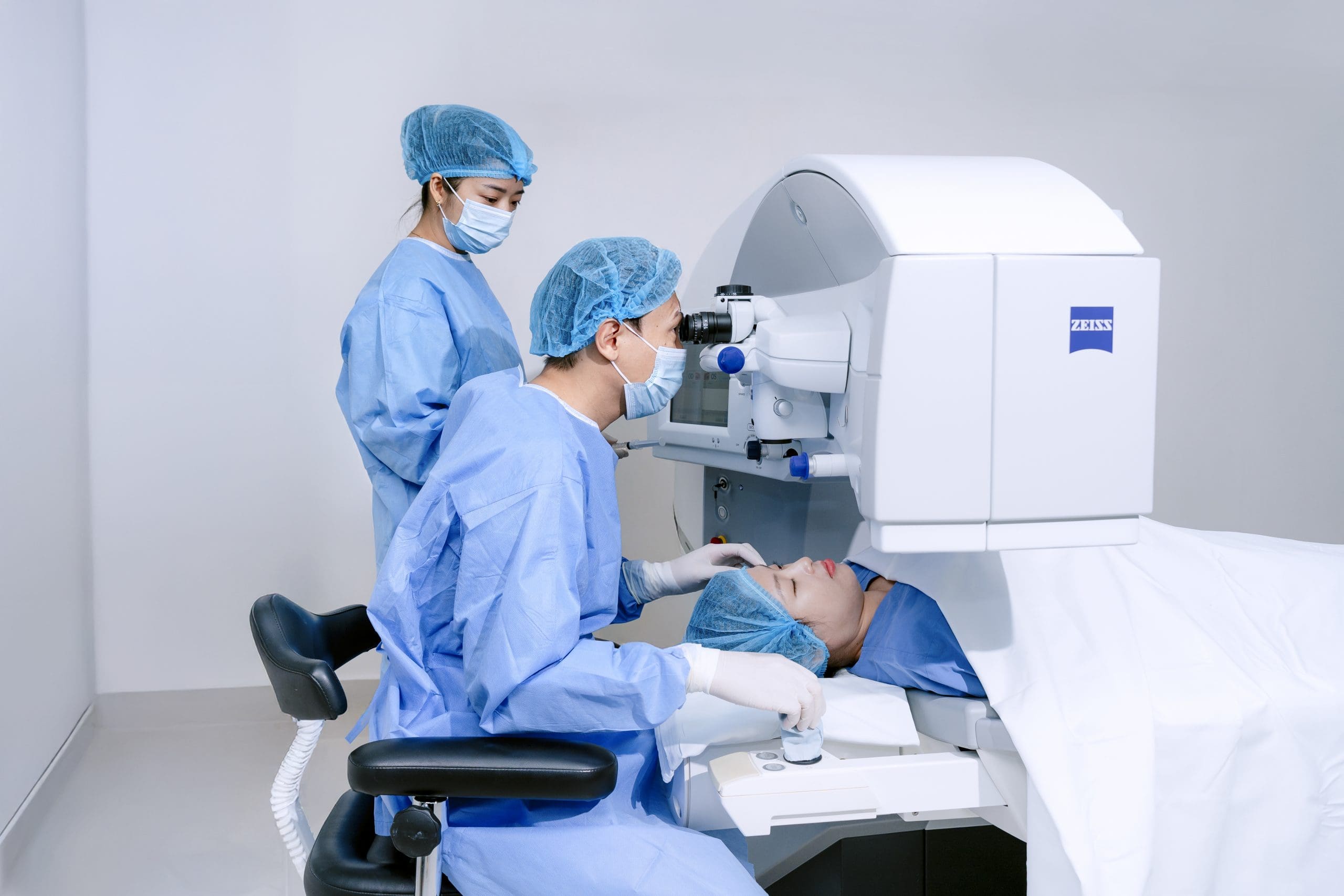
Comprehensive Preoperative Examination Process for Phakic ICL
At An Sinh Hospital, Phakic ICL is commonly indicated for the following cases:
- High myopia, hyperopia, or astigmatism beyond the safe limits of laser surgery.
- Thin corneas, not eligible for LASIK/PRK.
- Chronic dry eye sufferers.
- Stable refractive error for at least 1 year.
- Adults (typically aged 21–45 years).
- No serious ocular conditions such as uncontrolled glaucoma, intraocular inflammation, or progressive cataracts.
However, to determine whether Phakic ICL is truly appropriate, patients must undergo a comprehensive preoperative examination process.
Comprehensive Preoperative Examination for Phakic ICL
Preoperative assessment plays a decisive role in ensuring both the accuracy and safety of the surgery. At An Sinh Hospital, the comprehensive examination process typically lasts about two hours and is performed using advanced ophthalmic diagnostic equipment.
The doctor will conduct a precise refraction test to determine the degree of myopia, hyperopia, and astigmatism. Corneal topography is performed to assess corneal curvature and detect potential abnormalities such as keratoconus. Anterior segment biometry measures anterior chamber depth—an essential factor in determining adequate space for lens implantation.
Endothelial cell density measurement is mandatory, as it must meet age-specific safety thresholds. Optical Coherence Tomography (OCT) is performed to evaluate the optic nerve head and central retina, while UBM ultrasound assists in accurately calculating the appropriate ICL lens size.
Peripheral retinal examination helps detect early tears or degenerative lesions, which will be treated prior to surgery if necessary. After compiling all diagnostic data, the doctor will provide detailed counseling regarding surgical eligibility, benefits, potential risks, and expected visual outcomes.
The Phakic ICL lenses used at An Sinh Hospital are manufactured by STAAR Surgical, a global ophthalmic brand certified under the EN ISO 13485:2016 quality management system. Each lens is custom-designed based on the patient’s specific ocular parameters and ordered from abroad; therefore, the waiting time is usually around 2–3 weeks.
Phakic ICL Surgical Procedure at An Sinh Hospital

Phakic ICL Surgical Procedure at An Sinh Hospital
Phakic ICL surgery is a gentle procedure that takes approximately 20–30 minutes per eye, and patients can return home the same day.
First, the eye is disinfected and anesthetic eye drops are applied, so the patient feels no pain. The surgeon creates a very small incision at the corneal edge. The folded lens is then inserted through this incision and carefully positioned behind the iris.
Due to the small incision size, sutures are usually not required. After completion, intraocular pressure and lens positioning are rechecked. Typically, one eye is operated on first, and the second eye is scheduled on the following day to ensure maximum safety. Throughout the procedure, the patient remains awake but pain-free. If anxiety persists, mild oral sedation may be provided as prescribed by the doctor.
An Sinh Hospital focuses on three core factors: accurate diagnosis, proper indication, and safe surgery. Investment in modern equipment along with a team of refractive surgery specialists ensures high precision in lens implantation. Beyond the surgery itself, the hospital provides thorough postoperative care, detailed guidance, and long-term follow-up to ensure stable and lasting visual outcomes.
Postoperative Care and Follow-Up
After surgery, vision typically improves significantly within 24–48 hours. Patients may resume light daily activities, avoid rubbing their eyes, and strictly follow prescribed anti-inflammatory and antibiotic eye drop regimens.
An Sinh Hospital schedules regular follow-up visits: the first day after surgery, then at 1 week, 1 month, 3 months, and 6 months. These follow-ups help monitor intraocular pressure, lens position, and endothelial cell density.
Most patients achieve 20/20 vision or visual acuity equivalent to their best-corrected preoperative vision. Thanks to its stable fixation inside the eye, the lens does not shift during vigorous activities and does not cause discomfort.

.svg) Hotline
Hotline Appointment
 https://www.ansinh.com.vn/
 10 Trần Huy Liệu, Ward 11, Phú Nhuận District, Ho Chi Minh City
 Opening Hours

 30/09/2026





 0916.741.763