

 vi
vi 25-Jan-2026
 5,035
5,035 What Is Myopia? Why Is It Important to Choose the Right Myopia Correction Method?
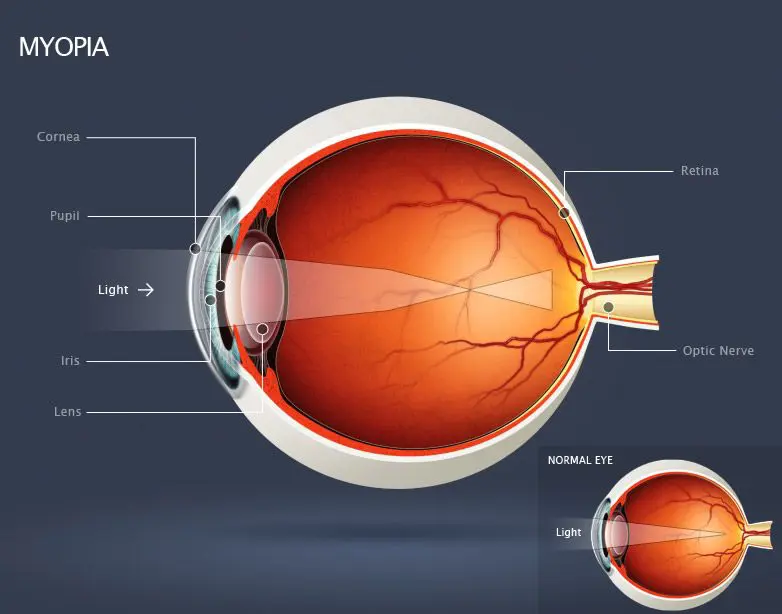
What is myopia? Why is choosing the right vision correction method important?
Myopia is a refractive error that occurs when light rays focus in front of the retina instead of directly on it, causing clear vision at near distances but blurred vision when looking far away. Common causes include an elongated eyeball, excessive corneal curvature, or a combination of genetic and environmental factors such as prolonged use of electronic devices and intensive study habits.
Common symptoms include:
- Blurred vision when viewing road signs, classroom boards, or projection screens
- Squinting, eye strain, dry eyes
- Headaches after prolonged distance viewing
- Children sitting very close to the TV or holding books close to their eyes
At first, glasses and contact lenses can help improve vision. However, as myopia gradually increases over time, dependence on corrective lenses not only causes inconvenience in daily life but also affects appearance, psychology, and work performance. As a result, the demand for permanent myopia correction solutions has become increasingly apparent.
However, not all eyes are the same, and not every vision correction method is suitable for everyone.
Myopia: An Alarming Situation in Vietnam

Myopia: An alarming situation in Vietnam
Over the past decade, myopia has become a “silent epidemic,” particularly in Asian countries. According to the World Health Organization (WHO), by 2030, approximately 50% of the global population may be affected by myopia, with the proportion of high myopia (≥ -6.00D) continuing to rise.
In Vietnam, the prevalence of myopia among urban students has exceeded 40–50%, and is even higher in major cities. Long-term dependence on glasses or contact lenses not only causes inconvenience in daily activities, work, and sports, but also impacts appearance and overall quality of life.
Therefore, refractive surgery is increasingly considered a proactive solution to improve vision and reduce dependence on corrective lenses.
Common Myopia Correction Methods in 2026
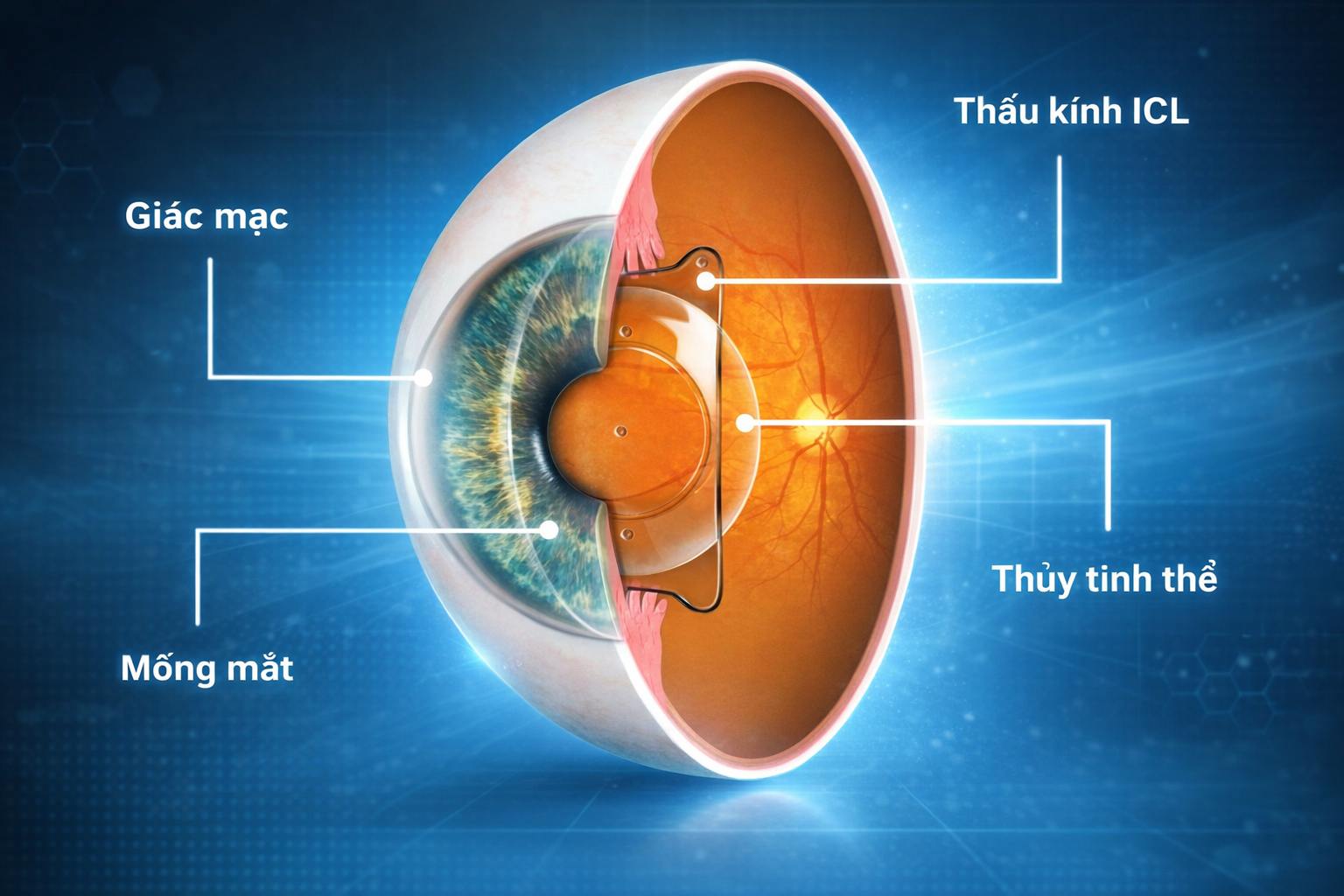
Phakic ICL – a common myopia correction method in 2026
1. Phakic ICL
In recent years, Phakic ICL has gradually reshaped the traditional perception of refractive surgery. While laser-based procedures were once considered the default choice, by 2026 an increasing number of ophthalmologists and patients are proactively considering Phakic ICL as a preferred option, especially in cases of high myopia or when the cornea is not ideal for laser treatment.
Phakic ICL corrects myopia by implanting a soft, ultra-thin intraocular lens inside the eye, positioned behind the iris and in front of the natural crystalline lens. This lens functions like an “internal refractive correction lens,” allowing light to focus accurately on the retina without removing corneal tissue or creating a corneal flap.
The core distinction of Phakic ICL lies in its treatment philosophy. Instead of intervening on the cornea, this method preserves the corneal structure almost entirely—an aspect that modern ophthalmology increasingly values when assessing long-term safety. This is precisely why Phakic ICL is particularly suitable for patients with thin or structurally weak corneas, or for those who have previously been advised that they are not candidates for laser surgery.
In terms of indications, Phakic ICL can correct myopia of up to approximately -18 diopters and astigmatism up to 6 diopters, exceeding the capabilities of most laser-based procedures. Beyond simply eliminating refractive error, numerous clinical studies have shown that postoperative visual quality—especially contrast sensitivity and night vision—is often excellent and stable.
Another important advantage, often overlooked initially by patients, is flexibility. If necessary, the Phakic ICL lens can be removed or replaced without causing permanent damage to the cornea. For younger patients, this represents a significant benefit as ophthalmology continues to move toward solutions that can adapt over time to physiological changes.
2. Femto LASIK
Femto LASIK remains one of the most commonly performed myopia correction procedures in Vietnam and worldwide. This method combines femtosecond laser technology to create a corneal flap with excimer laser treatment to reshape the cornea, allowing images to focus correctly on the retina.
The greatest advantage of Femto LASIK is speed. Surgical time is short, the procedure is generally comfortable, and visual improvement can be noticeable within one to two days. For patients with mild to moderate myopia, sufficient corneal thickness, and a desire for rapid recovery to return to work, Femto LASIK remains a reasonable option.
However, Femto LASIK is still a myopia correction procedure that directly alters the cornea. Creating a flap, even with precise laser control, changes the cornea’s biomechanical structure. In some patients, this may be associated with prolonged dry eye symptoms or glare, particularly for those who spend extended periods working on digital screens.
As a result, in treatment trends for 2026, Femto LASIK is increasingly prescribed more selectively rather than applied as a one-size-fits-all solution.
3. SMILE Pro
SMILE Pro is the next-generation evolution of SMILE surgery, utilizing the VisuMax 800 system with extremely short laser time and a very small corneal incision of approximately 2–3 mm. Compared to LASIK, SMILE Pro does not require flap creation, helping to better preserve corneal structure and reduce the risk of postoperative dry eye.
This method is particularly suitable for young patients, athletes, or individuals with active lifestyles, as the cornea maintains greater biomechanical stability compared to traditional LASIK. Visual recovery after SMILE Pro is typically rapid, with minimal discomfort and fewer surface-related complications.
Nevertheless, SMILE Pro still depends on corneal thickness and has certain limitations regarding the degree of myopia and astigmatism it can correct. For patients with very high myopia or thin corneas, SMILE Pro may not be the optimal choice, and Phakic ICL is often considered as an alternative.
Which Myopia Correction Method Should You Choose in 2026?
| Method | Corneal Impact | High Myopia | Thin Cornea | Reversibility |
|---|---|---|---|---|
| Femto LASIK | Yes | Moderate | No | No |
| SMILE Pro | Yes | Moderate | Limited | No |
| Phakic ICL | No | Very high | Highly suitable | Yes |
There is no single myopia correction method that is suitable for everyone. Femto LASIK is appropriate for those seeking rapid results and who meet corneal criteria. SMILE Pro offers a balance between minimal invasiveness and effectiveness. Meanwhile, Phakic ICL is emerging as a comprehensive solution for eyes that demand higher standards of safety, structural preservation, and long-term visual quality.
The most important factor is not choosing the newest or most expensive procedure, but selecting the method that best matches the eye’s structure and the patient’s visual needs. A thorough examination and in-depth consultation with an experienced refractive surgeon remain the decisive steps before making a final choice.

 25/01/2026













 0916.741.763
 Appointment