

 vi
vi 21-Dec-2025
 15,010
 Why Is Eliminating Nearsightedness So Challenging?

Dr. Tran Van Ket and Ms. Ly
This question was raised in the case of Ms. N.T. Ly, 29 years old, currently living and working in Ho Chi Minh City. Ms. Ly shared that both of her eyes suffered from severe myopia of more than 10 diopters, accompanied by astigmatism. This condition forced her to wear glasses constantly throughout her work and daily life. The thick and heavy 10-diopter glasses had long been a burden, affecting her health as well as her ability to take care of her family.
With strong determination, she and her husband began the journey to eliminate her myopia by visiting many hospitals and eye treatment centers in Ho Chi Minh City. However, the outcome was beyond expectation, as she repeatedly received refusals and headshakes from doctors. After examinations, doctors concluded that her corneas were very thin and cone-shaped, meaning surgery was NOT POSSIBLE.
After an entire month of going back and forth between hospitals, Ms. Ly almost lost all hope, believing she would have to live with her thick glasses forever. Fortunately, luck smiled on her during a visit to her husband’s hometown in Can Tho. After sharing her difficulties, she was encouraged by her family to visit Saigon Eye Hospital Can Tho for a re-examination with Dr. Tran Van Ket. There, following an in-depth evaluation, Dr. Ket concluded that her eyes were suitable for surgery using the PHAKIC ICL method. Ms. Ly could hardly contain her emotions.
According to the hospital’s treatment protocol, her vision has now almost fully recovered to nearly 10/10. She can clearly see both near and far objects without the need for glasses.
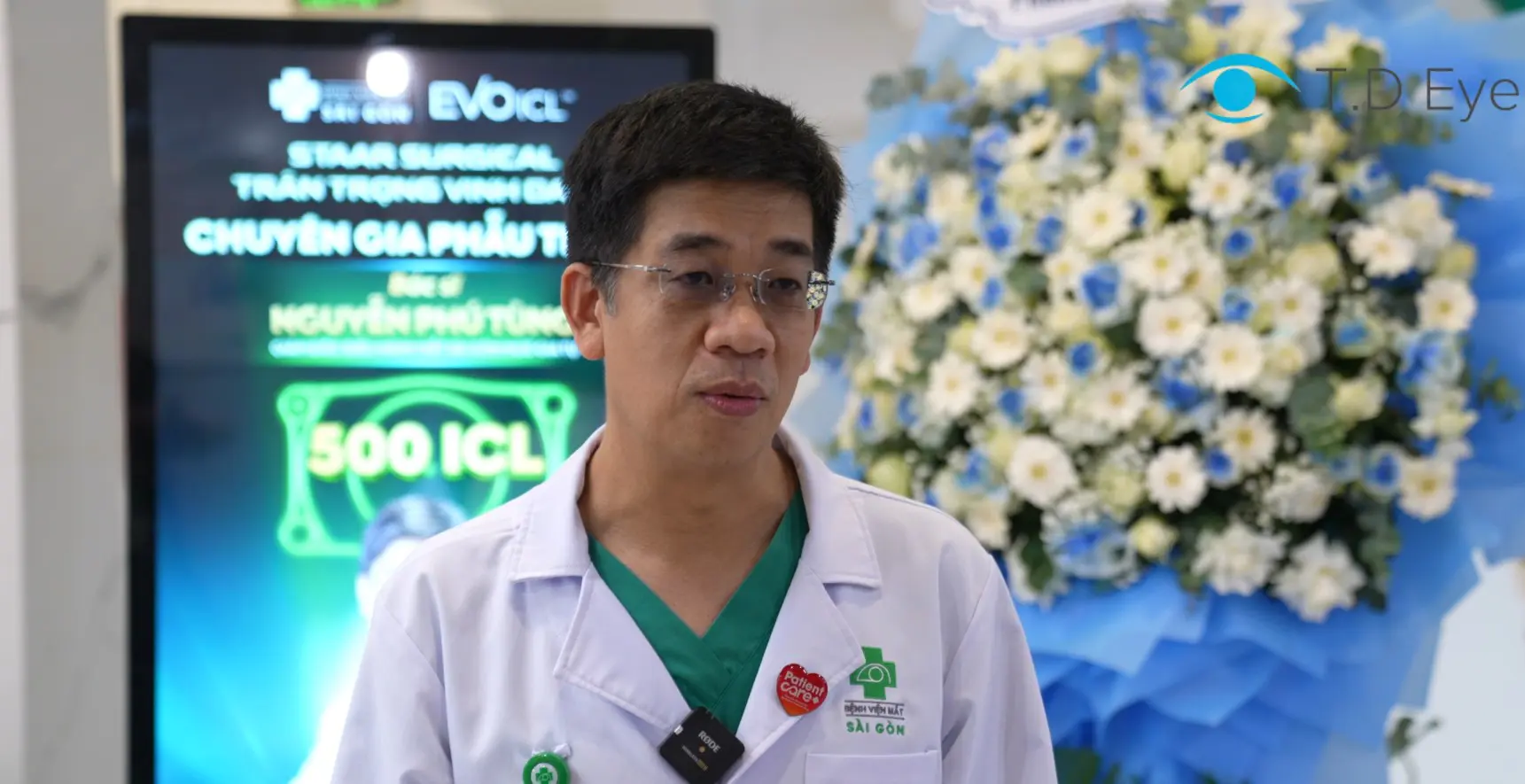
Dr. Tran Van Ket Shares Insights on the PHAKIC ICL Method
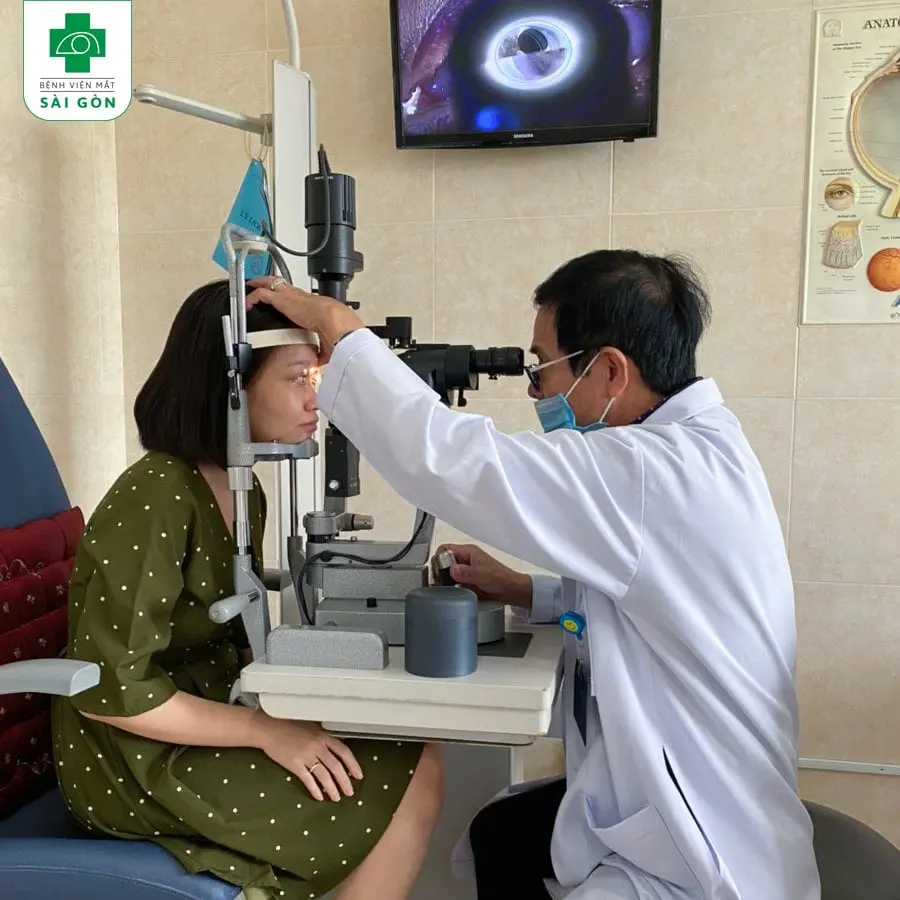
Dr. Ket concluded that Ms. Ly’s eyes were suitable for surgery using the PHAKIC ICL method
“For patients with typical myopia (generally below 8 diopters), conventional refractive procedures can be considered, such as Standard LASIK (microkeratome-assisted ophthalmic surgery using laser), Femtosecond LASIK (a bladeless laser-only refractive procedure), or ReLEx SMILE (an advanced refractive surgery that corrects myopia by removing a thin layer of corneal tissue through a very small incision).
However, for patients with high myopia ranging from –8 diopters to –18 diopters, accompanied by astigmatism, and especially those with naturally very thin corneal structures, these three conventional methods are completely unsuitable. In such cases, doctors will indicate treatment using the Phakic ICL method.
The Phakic ICL method belongs to the highest-level techniques among treatments for myopia, hyperopia, and astigmatism, offering high effectiveness and visual quality. Therefore, it requires strict standards in the surgeon’s expertise as well as the surgical team’s proficiency.
Before proceeding with intraocular lens implantation surgery, patients undergo extremely meticulous measurements, ranging from standard myopia and astigmatism assessments to evaluations of anterior chamber width, angle measurements, corneal thickness, and corneal surface contour characteristics. These are conducted using specialized equipment such as anterior segment optical coherence tomography (Anterion OCT), corneal topography systems (Pentacam), corneal diameter calipers, and anterior chamber depth assessment with Anterion.
All of these measurements are then sent to a specialized artificial lens manufacturer in the United States to custom-order a lens specifically tailored for the patient. This custom lens is made exclusively for that individual patient and cannot be used for anyone else. Typically, the waiting time for the lens to arrive in Vietnam ranges from 3 to 6 weeks. Afterward, the doctor proceeds with Phakic ICL surgery to correct refractive errors for this rare group of patients.”

.svg) Hotline
Hotline Appointment
 https://matsaigoncantho.com/
 717 Đường 3/2, P. An Bình, Q. Ninh Kiều, Can Tho City
 Opening Hours

 21/02/2026



 0916.741.763