
 vi
vi 13-Nov-2025
 52,440
 School Myopia in the Modern Learning Environment

School myopia is progressing faster than ever in the digital age
Today, as learning becomes increasingly tied to screens and artificial lighting, school myopia has quietly evolved into a “silent epidemic.” According to the Ministry of Health, over 40% of Vietnamese students suffer from refractive errors, with myopia accounting for the majority.
Besides familiar causes such as studying for long hours, excessive screen time, or improper sitting posture, there is another overlooked culprit—light from study lamps. Choosing the wrong type of lamp, placing it incorrectly, or using it improperly forces the eyes to constantly adjust focus, leading to fatigue, dryness, and gradually increasing the risk of school myopia.
Many parents believe that investing in an expensive desk lamp is enough to protect their children’s eyes. In reality, improper artificial lighting can silently damage vision over time.
Mistake #1: Believing that “anti-myopia lamps” are enough

Many parents are willing to invest in expensive lamps hoping to protect their child’s eyes from school myopia.
On the market today, countless products are labeled as “anti-myopia lamps,” “eye-protection lighting,” or “school-standard lamps.” However, not all of them meet the optical standards suitable for children.
A good study lamp must provide stable, flicker-free lighting. Although flickering may be imperceptible to the naked eye, it forces the eye muscles to work constantly—causing strain and fatigue, which are major contributors to school myopia.
In addition, the Color Rendering Index (CRI) is an important factor often overlooked. A CRI above 80 allows accurate color perception, reducing the effort needed for children to read clearly and preventing unnecessary eye strain.
Beyond light quality, brightness and color temperature are also crucial. Lights that are too bright can cause glare, while those too dim force the eyes to overwork. Ideally, LED desk lamps should have a power range of 5W–10W and a color temperature between 5000K–6500K for cool or neutral white light. Modern lamps that allow brightness and color temperature adjustment can help children adapt lighting to various study activities such as reading or relaxation.
Mistake #2: Incorrect lamp position and lighting angle
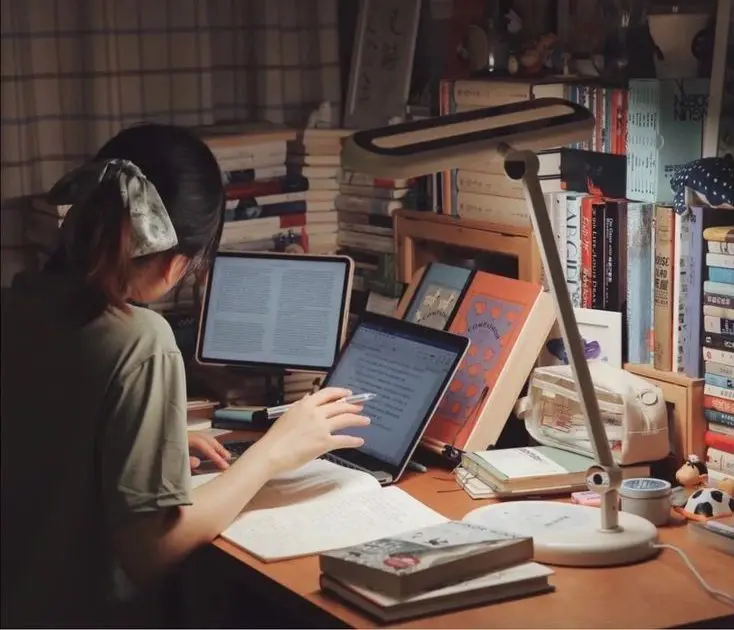
The golden rule when placing a study lamp is to avoid hand shadows while writing.
Buying a good lamp is only the first step. The placement and distribution of light in the study area also directly affect a child’s vision.
The most important rule is to avoid hand shadows while writing. If your child is right-handed, place the lamp on the left; if left-handed, place it on the right. Additionally, the desk lamp should be on the same side as the main room light to prevent large light–dark contrasts, which force the eyes to adjust constantly and may lead to school myopia.
The height of the lamp is equally important. It should be placed approximately 40–50 cm above the desk to evenly illuminate the workspace without shining directly into the eyes. Opt for lamps with adjustable arms and shades so you can modify the lighting direction as needed.
Direct glare or reflections from the lamp on laptop or phone screens can cause irregular pupil dilation, eye dryness, headaches, and reduced concentration. This explains why even children who study moderately can still develop school myopia.
Mistake #3: Ignoring human factors
No lamp, no matter how advanced, can protect your child’s eyes if they lack proper study and rest habits. Lighting is only one part of the equation—the real key lies in how children use their eyes daily.
An incredibly effective yet simple practice is the 20–20–20 rule: after every 20 minutes of studying, look 20 feet (about 6 meters) away for 20 seconds. This allows the eye muscles to relax, reducing strain and helping prevent school myopia.
Additionally, encourage your child to make use of natural light whenever possible. No artificial light source compares to sunlight—it’s even, gentle, and non-glaring. Studying near a window with diffused daylight helps the eyes stay comfortable and prevents accommodative stress.
Parents should also ensure balanced lighting throughout the room instead of relying solely on a desk lamp. Strong light–dark contrasts cause the eyes to constantly readjust, leading to eye fatigue, headaches, and early signs of school myopia.
A proper study lamp is the foundation of healthy eyes
A well-chosen study lamp not only improves concentration but also plays a vital role in preventing school myopia. When selecting one, parents should prioritize:
- High-quality LED lighting with stable, flicker-free output.
- CRI ≥ 80 with neutral or soft white light.
- Adjustable brightness and flexible light direction.
- Anti-glare design with soft light diffusion.
At the same time, teach children to keep a distance of 30–35 cm between their eyes and the notebook, maintain proper posture, and ensure even lighting throughout the study area. These small habits make a big difference in preserving eye health.
School myopia doesn’t just come from books or screens—it also stems from the lighting that surrounds children every day. Choosing the right lamp, positioning it correctly, and cultivating healthy study habits can save your child from early dependence on glasses.
Protecting your child’s eyes means protecting their future. Start with the smallest change—adjust that study lamp today.
 23/02/2026








 0916.741.763
 Appointment