

 vi
vi 30-Dec-2025
 24,795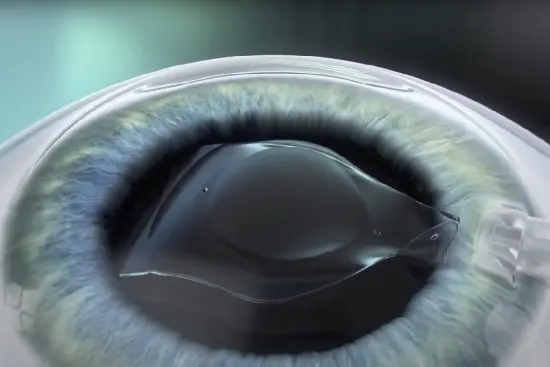
Myopia Surgery Review After Nearly 20 Years of Wearing Glasses

Myopia surgery review after nearly 20 years of wearing glasses with Phakic ICL. Photo: Vietnam–Russia International Eye Hospital
From a very young age, Ngoc Anh had to “live with” a thick pair of myopia glasses as an inseparable part of her daily life. For nearly 20 years, those glasses were almost an extension of herself—until the young woman born in 1999 decided to say goodbye to them through the Phakic procedure. This is also why Ngoc Anh wanted to share her honest myopia surgery review after a long journey of living with severe myopia.
Myopia is a common refractive error, but for Ngoc Anh, a very high degree of nearsightedness made everyday activities much more difficult. Her left eye had -9 diopters and her right eye reached -10 diopters, and she had been wearing glasses since the age of five. “For people with mild myopia, they can still brush their teeth, wash their face, or get dressed after waking up. For me, the very first thing I had to do was look for my glasses. Without them, I could barely see anything. For nearly 20 years, glasses were something I had to carry with me everywhere,” Ngoc Anh shared in her myopia surgery review.
Beyond daily inconvenience, changing glasses was also a constant frustration. Frames could be replaced quickly, but with such high myopia, her lenses always had to be custom-made. “Every time I changed my glasses, I had to wait about two days. During those days, it felt like the whole world around me was completely blurred,” she recalled.
A Turning Point with Phakic ICL
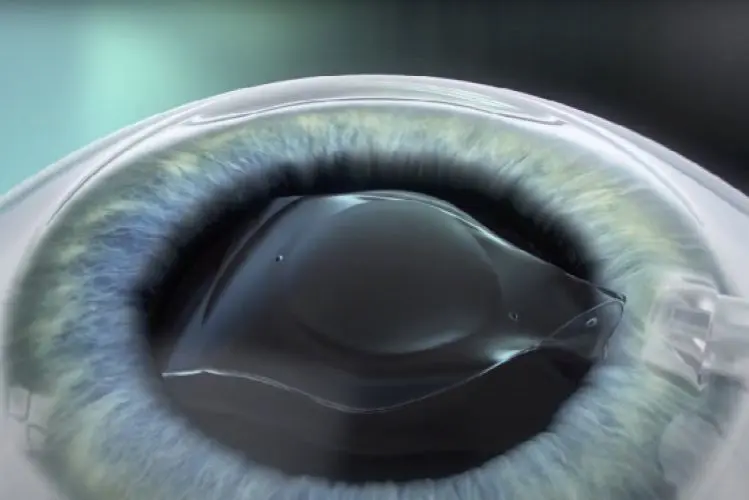
ICL lens inside the eye
Ngoc Anh’s journey to the Vietnam–Russia International Eye Hospital began with a recommendation from a friend who had previously undergone myopia surgery there. After carefully researching information on the hospital’s official fanpage, she decided to come in for an eye examination with the hope of regaining her vision. The examination results showed that her high degree of myopia and corneal condition were not suitable for conventional laser procedures. Instead, doctors advised her to choose the Phakic method, which involves implanting a biocompatible intraocular lens inside the eye. Just one week after having a new pair of glasses made, she made the decision to proceed with surgery.
The Surgical Journey
Ngoc Anh’s Phakic surgery journey turned out to be much gentler and more comfortable than she had imagined. In her myopia surgery review, she was particularly impressed that she was directly examined and operated on by Dr. Boris Fattakhov, MD, PhD—a leading refractive surgery specialist in Europe. “The doctor explained everything very carefully, and his surgical technique was fast and precise. Before the surgery, he even asked how I was feeling and encouraged me, which made me feel much more at ease, even though I was honestly a bit nervous,” Ngoc Anh recalled with a smile.
Two months after surgery, follow-up examinations showed that Ngoc Anh’s vision in both eyes had reached 9/10—an optimal level for someone who previously had very severe myopia. “The moment I stepped down from the operating table, I was so happy I almost cried. I couldn’t remember the last time I had seen everything so clearly. Since saying goodbye to my glasses, I’ve felt much more confident. Sometimes, out of habit, I still look for my glasses and then burst out laughing when I realize I no longer need them,” she shared emotionally in her myopia surgery review.
Ngoc Anh’s story is just one of many successful vision correction cases at the Vietnam–Russia International Eye Hospital. With decades of experience in ophthalmology, state-of-the-art equipment, and a team of European doctors working full-time, the hospital has become a trusted destination for millions of patients across Vietnam and the region. For many consecutive years, it has been recognized as the leading center for SMILE refractive surgery in Southeast Asia, affirming its reputation and treatment quality in refractive surgery.
Key Advantages of Phakic

Key advantages of Phakic – Myopia surgery review with ICL
- Phakic effectively treats severe myopia of up to -18 diopters, hyperopia up to +10 diopters, and high astigmatism. It is an optimal solution for patients who are not eligible for laser procedures.
- The intraocular lens is placed inside the eye without thinning or altering the corneal structure, making it especially suitable for patients with thin or weak corneas.
- Because it does not deeply affect the corneal surface, Phakic minimizes impact on tear glands, helping reduce dry eye, irritation, and discomfort after surgery.
- After surgery, patients achieve sharp visual quality with high contrast, seeing clearly both during the day and at night. Vision remains stable over time, suitable for those with high visual demands.
- Before and during surgery, anesthetic eye drops are used, so patients do not feel pain. The procedure is quick, with a very small incision, ensuring safety.
- Vision improves significantly within 24–48 hours. Most patients experience little to no foreign-body sensation and can quickly return to normal daily activities.
- The lens is made from highly biocompatible material with UV protection, helping shield the eyes from sunlight and ensuring long-term durability.
- Each lens is custom-manufactured based on precise individual eye measurements, delivering high accuracy and optimal visual outcomes.
Phakic surgery is one of the advanced vision correction methods currently offered within the hospital system. Although the cost is higher due to personalized lens manufacturing, it provides a valuable opportunity to restore clear, natural, and safe vision for those who once believed they had “no remaining options.”
 23/02/2026













 0916.741.763
 Appointment