

 vi
vi 21-Dec-2025
 17,100
Severe myopia and astigmatism have long been major “barriers” for many people who wish to free themselves from glasses or contact lenses. Not everyone is suitable for corneal laser procedures such as LASIK or SMILE, especially those with thin corneas or very high refractive errors. In this context, Phakic ICL is considered an optimal, safe, and effective solution for patients with high myopia and astigmatism in Ho Chi Minh City and Can Tho.
Phakic ICL Intraocular Lens Material

What is the material of the Phakic ICL intraocular lens?
Phakic ICL is a lifesaver for eyes with high refractive errors (up to 30 diopters of myopia, 10 diopters of astigmatism, and 15 diopters of hyperopia) or thin corneas that do not meet the criteria for other vision correction methods.
The core factor that sets Phakic ICL apart lies in its premium hydrophilic Collamer material—an exclusive material developed specifically for ophthalmology.
Collamer has a unique structure:
- An outer layer containing collagen, highly biocompatible with the intraocular environment
- A flexible polymer core with long-term stability
Thanks to these properties, the lens is just over 100 microns thick, soft and flexible, allowing patients to feel no sensation of the lens after surgery. In addition, Collamer is bonded with a UV-blocking chromophore, helping protect the eyes from the long-term harmful effects of sunlight.
This high level of safety, stability, and biocompatibility has made Phakic ICL a popular choice in many developed countries such as the United States, France, Germany, Switzerland, and Singapore.
Where Is the Phakic ICL Placed in the Eye? Is It Safe and Durable?
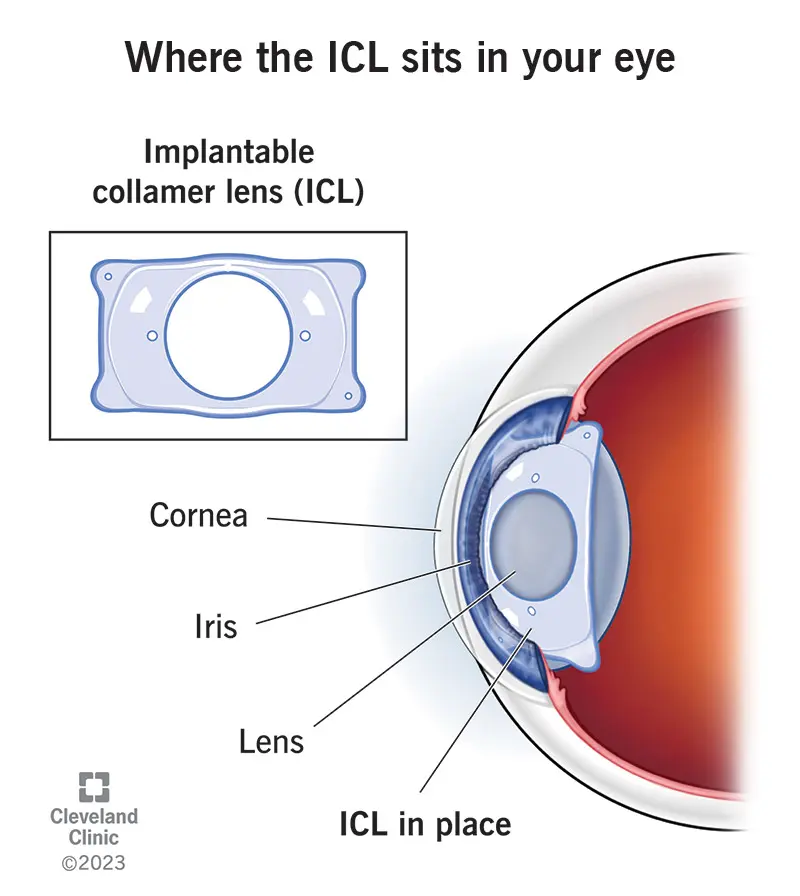
Where is the Phakic ICL placed in the eye? Is it safe and durable?
One of the most common concerns is the lens placement position and the risk of damage after implantation.
In practice, the Phakic ICL is placed behind the iris and in front of the natural crystalline lens. This position allows the lens to function like an “intraocular refractive lens,” directly correcting vision without causing damage to the cornea.
In terms of safety:
- The lens cannot break thanks to its specially designed flexible structure
- Positioned deep inside the eye, it is not directly affected by dust, smoke, or heat
- The natural blinking reflex always protects the eyeball from external factors
With this mechanism, Phakic ICL can correct myopia up to 30 diopters, hyperopia up to 15 diopters, and astigmatism up to 10 diopters, making it highly suitable for complex refractive cases.
The 12-Step Preoperative Examination Process

12-step preoperative examination process for PHAKIC surgery at Saigon Eye Hospital – Can Tho
Unlike many other methods, Phakic ICL is not applied universally but is fully personalized for each individual eye. Therefore, the preoperative examination plays a decisive role.
At specialized centers in Ho Chi Minh City and Can Tho, patients undergo a standard 12-step examination process, including:
- Accurate measurement of myopia and astigmatism
- Assessment of anterior chamber depth
- Evaluation of endothelial cell density
- Comprehensive analysis of ocular structure and overall eye health
Based on these data, doctors will design a customized Phakic ICL, ensuring high precision, long-term safety, and optimal postoperative visual quality.
Beyond delivering clear vision, Phakic ICL also provides long-term peace of mind thanks to:
- No alteration of corneal structure
- Suitable for severe myopia and astigmatism, as well as thin corneas
- Safe materials with high biocompatibility
- Stable and comfortable visual experience
With the advancement of modern ophthalmology, correcting severe myopia and astigmatism in Ho Chi Minh City – Can Tho with Phakic ICL is no longer an “impossible” option, but has become a scientific, personalized, and sustainable solution for long-term eye health.

.svg) Hotline
Hotline Appointment
 https://matsaigoncantho.com/
 717 Đường 3/2, P. An Bình, Q. Ninh Kiều, Can Tho City
 Opening Hours

 21/02/2026






 0916.741.763