

 vi
vi 15-Jan-2026
 500,460
 The General Context in 2026

The general context of myopia in 2026 and the Phakic ICL trend
Entering 2026, high myopia is no longer an isolated condition but has become a widespread public health challenge, particularly in Asian countries. Prolonged screen exposure, intense academic and work pressure, and limited access to natural daylight have contributed to a growing prevalence of high myopia, significant astigmatism, and thin corneas.
At the same time, patient awareness has evolved markedly. Whereas the primary goal of refractive surgery in the past was simply “clear vision without glasses,” by 2026 patients are placing greater emphasis on long-term safety, night vision quality, and preservation of ocular structure. This shift in priorities has reshaped surgical indications, with Phakic ICL emerging as a key solution for patients with high myopia.
What Is Phakic ICL?
Phakic ICL (Implantable Collamer Lens) is a soft, ultra-thin intraocular lens implanted inside the eye to correct refractive errors such as myopia and astigmatism. The lens is positioned behind the iris and in front of the natural crystalline lens, functioning as an “additional lens” that precisely focuses light onto the retina.
Unlike laser-based procedures, Phakic ICL does not cause damage to the cornea or alter the surface structure of the eye. This makes it particularly suitable for individuals with thin corneas, high myopia, or significant astigmatism—groups that often face limitations with conventional laser refractive surgery.
Technological Advances in Phakic ICL by 2026
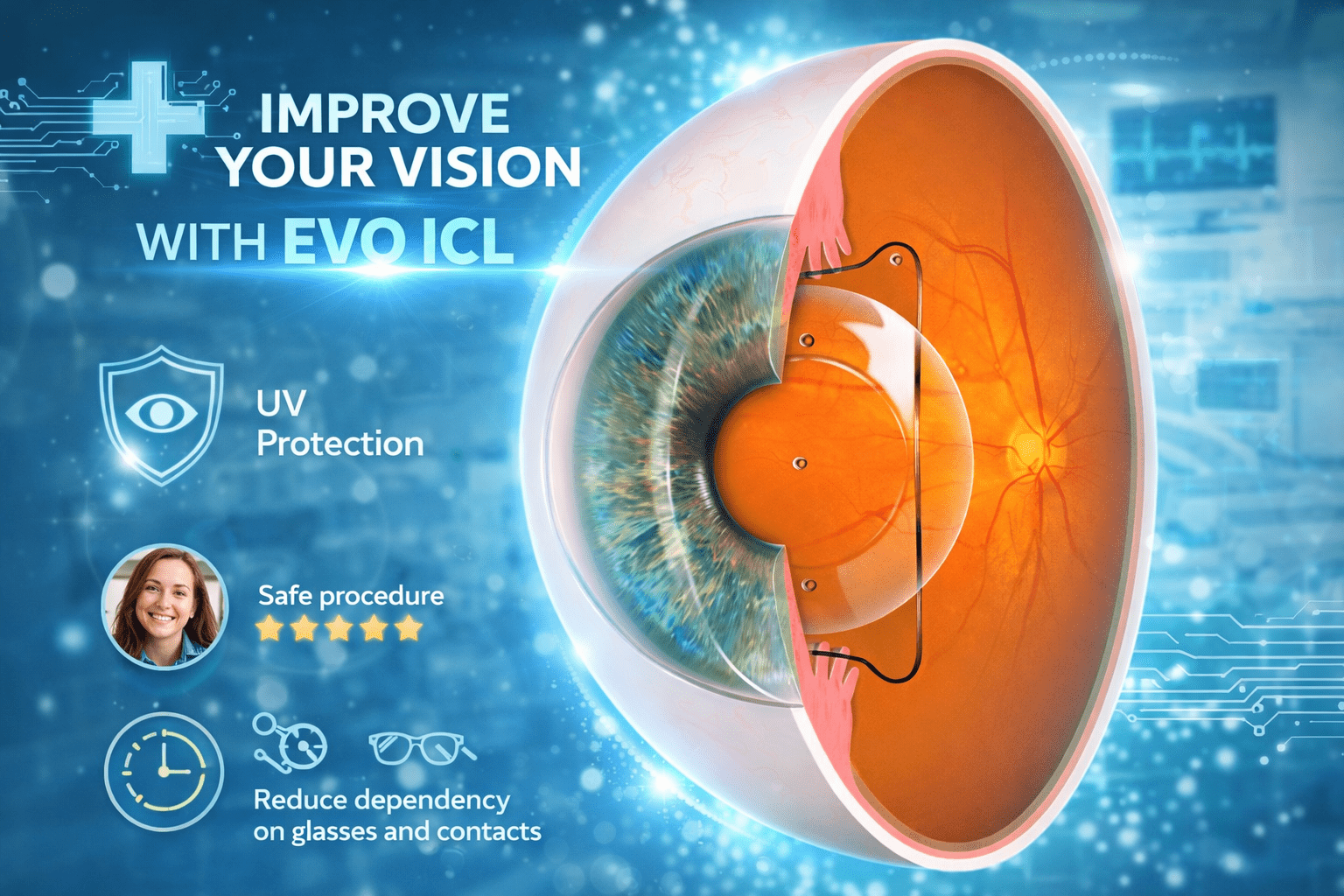
Technological advances in Phakic ICL by 2026
By 2026, Phakic ICL has undergone significant improvements in both design and safety standards. The Collamer material continues to be optimized for high biocompatibility, reducing inflammatory reactions and maintaining long-term optical clarity.
Lens design has become increasingly personalized, based on detailed anatomical parameters of each eye, such as anterior chamber depth, white-to-white diameter, and the degree of astigmatism. This personalization enhances postoperative lens stability and minimizes risks such as elevated intraocular pressure or intraocular tissue contact.
In addition, measurement and surgical planning processes are now supported by advanced diagnostic systems, enabling surgeons to predict visual outcomes with greater accuracy compared to earlier generations.
Who Is a Suitable Candidate for Phakic ICL Surgery?
Phakic ICL is not a universal solution, but it plays a critical role in the treatment of high myopia. Candidates commonly considered by ophthalmologists include:
- Individuals within an appropriate and safe age range
- Patients with high myopia exceeding the safe limits of laser procedures
- Those with thin corneas or corneal structures unsuitable for laser surgery
- Patients with high astigmatism requiring precise visual correction
- Individuals seeking to preserve corneal integrity and maintain future treatment options
Before making a decision, patients must undergo comprehensive examinations to assess ocular structure and rule out contraindications.
The Phakic ICL Surgical Procedure

ICL lens made of soft, biocompatible Collamer material
Phakic ICL surgery is performed following a strict standardized protocol. Prior to surgery, patients undergo detailed examinations to accurately measure ocular parameters.
On the day of surgery, local anesthesia is applied, and the lens is inserted through a very small incision. The procedure is typically brief, painless, and allows patients to return home the same day. Vision improves rapidly after surgery; however, follow-up visits are essential to monitor lens stability and intraocular pressure.
Advantages of Phakic ICL
In the context of 2026, Phakic ICL is highly regarded for several key advantages:
- Preserves the cornea without thinning or altering its surface structure
- Excellent visual quality, especially under low-light conditions
- Well suited for high myopia and significant astigmatism
- Can be removed if necessary, offering long-term treatment flexibility
These advantages explain why Phakic ICL is increasingly regarded as a strategic solution for patients with high myopia.
An Ophthalmologist’s Perspective
From a clinical standpoint, many ophthalmologists consider Phakic ICL not merely an alternative, but a more appropriate long-term approach for high myopia. By avoiding corneal intervention, the procedure reduces risks such as dry eye, corneal ectasia, and long-term degradation of visual quality.
However, surgeons emphasize that the success of Phakic ICL depends heavily on thorough preoperative evaluation, proper patient selection, and surgical expertise. This is not a “one-size-fits-all” procedure, but one that requires individualized planning for each patient.
Phakic ICL Cost in 2026
Cost is a major concern for many individuals exploring Phakic ICL. Below is a reference table intended for informational purposes and completion:
| Hospital | Address | Responsible Doctor | Cost |
|---|---|---|---|
| Anh Sang Eye Hospital | 2 Alley 208 Tran Cung, Co Nhue Ward, Bac Tu Liem District, Hanoi | Assoc. Prof. Dr. Vu Thi Thanh | 70,000,000 – 90,000,000 VND / both eyes |
| Hai Yen Eye Care Center | 31A Nguyen Dinh Chieu, Da Kao Ward, District 1, Ho Chi Minh City | Assoc. Prof. Dr. Tran Hai Yen | 80,000,000 – 90,000,000 VND / both eyes |
| Viet Nga International Eye Hospital (Hanoi) | No. 9 Nguyen Do Cung Street, Nghia Do Ward, Hanoi | Dr. Bui Thi Thu Huong | 80,000,000 – 90,000,000 VND / both eyes |
| Japan International Eye Hospital | 32 Pho Duc Chinh Street, Ba Dinh District, Hanoi | Dr. Bui Tien Hung | 80,000,000 – 90,000,000 VND / both eyes |
| Saigon Eye Hospital – Ngo Gia Tu | Ngo Gia Tu Street, Ward 2, District 10, Ho Chi Minh City | Dr. Nguyen Phu Tung | 80,000,000 – 90,000,000 VND / both eyes |
Actual costs may vary depending on lens type, ocular condition, and additional services at each medical facility.
Patient Experience and Expectations in 2026
In 2026, patients approach surgery with a more proactive mindset. They seek not only rapid visual improvement but also long-term reassurance. Postoperative experiences with Phakic ICL are often described as sharp, stable vision with minimal fluctuation and limited disruption to daily activities.
Most importantly, patients feel reassured knowing that their corneal structure is preserved and that multiple treatment options remain available in the future if needed.

 14/10/2026











 0916.741.763
 Appointment