

 vi
vi 12-Jan-2026
 67,260
Lazy eye in young children needs early intervention
In recent years, vision problems in children have become a major concern for families and society. According to a 2024 survey by the Vietnam Ophthalmology Council, there are currently around 5 million children nationwide with refractive errors, accounting for 30–40% of school-age children. Notably, in major cities such as Hanoi and Ho Chi Minh City, more than 50% of children are affected by vision problems, with myopia accounting for the highest proportion.
In addition to myopia, hyperopia, and astigmatism, a silent yet particularly dangerous condition in young children is lazy eye (amblyopia). If not detected and treated at the right time, this condition can result in permanent and irreversible vision loss.
What is lazy eye?
Lazy eye (medical term: Amblyopia) is a condition in which the visual acuity of one or both eyes is reduced, not due to structural damage to the eye but because the brain does not receive and process images from that eye during visual development.
In young children, the brain tends to “prioritize” the eye with clearer vision and gradually ignore signals from the weaker eye, causing that eye to become increasingly inactive. What is concerning is that children are often unaware of the problem and do not complain, as the brain has adapted from a very early age.
If not detected and treated before the “golden period” (usually before the ages of 7–8), lazy eye can lead to permanent functional blindness.
The current situation of lazy eye in children
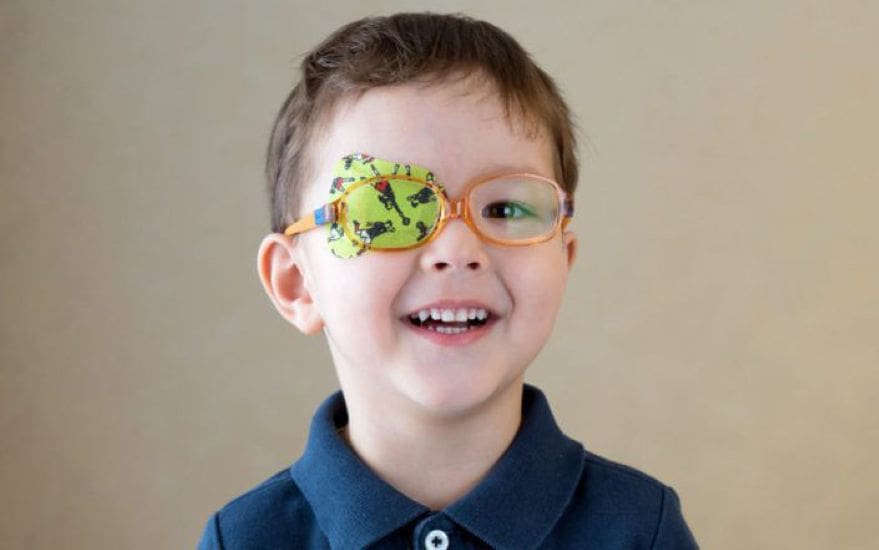
The current situation of lazy eye in children
According to clinical studies, lazy eye affects approximately 1–5% of children under 6 years old. However, the actual number may be higher, as many cases are not screened early.
Reasons for the increasing rate of visual problems in children include:
- Prolonged study time and excessive use of electronic devices
- Incorrect study posture and inadequate lighting
- Lack of regular eye examinations
- Parental complacency when children show no obvious symptoms
Classification of lazy eye severity
Based on measured visual acuity, lazy eye is classified into three levels:
1. Mild lazy eye
- Visual acuity from 20/40 to below 20/30.
- The child can still see the larger lines on the vision chart, but visual function has begun to decline.
2. Moderate lazy eye
- Visual acuity from 20/200 to 20/50.
- Significant reduction in detail vision, causing difficulties in learning and daily activities.
3. Severe lazy eye
- Visual acuity below 20/200.
- The child can barely see the vision chart, with a very high risk of permanent vision loss if not treated early.
Causes of lazy eye in children

Causes of lazy eye in children
1. Strabismus
Strabismus causes the two eyes to be misaligned. The brain is forced to suppress images from the deviated eye to avoid double vision, which over time leads to lazy eye.
2. Uncorrected refractive errors
Severe myopia, hyperopia, or astigmatism in one eye, if not detected and corrected early, can cause the brain to ignore the weaker eye.
3. Visual axis obstruction
This includes congenital ptosis, congenital cataracts, and corneal diseases. These conditions block light from entering the eye, disrupting visual development.
4. Other risk factors
- Premature birth or low birth weight
- Family history of eye or vision problems
- Delayed physical or intellectual development
Signs of lazy eye in young children
Parents should pay close attention if a child shows the following signs:
- Frequent squinting or closing one eye when looking
- Tilting the head or turning the neck when focusing on objects
- Frequent eye rubbing, eye strain, or excessive blinking
- Difficulty catching a ball, drawing inaccurately, slow reading
- Visible strabismus or drooping eyelids
These signs are often mistaken for bad habits, while they may actually be early indicators of lazy eye.
Serious complications of lazy eye
If not treated promptly, lazy eye can lead to:
- Permanent vision loss
- Reduced binocular coordination
- Difficulties in learning, reading, and movement
- Increased risk of injury due to poor spatial awareness
- Progressive worsening of strabismus
Many studies show that the healthy eye may also be affected due to abnormal binocular visual function.
Can lazy eye be treated?
YES.
Lazy eye can be effectively treated, especially when detected early. Treatment is most effective in children under 7 years old. The later the treatment, the longer it takes and the lower the chance of full recovery.
Methods for diagnosing lazy eye
Ophthalmologists typically combine multiple methods:
1. Regular vision screening
Eye examinations should begin early and be repeated annually.
2. Photo screening
Suitable for young children who cannot read vision charts or those with developmental delays.
3. Advanced diagnostic tests
These include cover tests, refraction measurements, fundus examination, or slit-lamp examination.
How is lazy eye treated?
The goal of treatment is to force the brain to use the weaker eye, thereby restoring visual function.
- Patching the stronger eye to stimulate the weaker eye.
- Wearing properly prescribed glasses or contact lenses.
- Using atropine eye drops to temporarily blur the stronger eye, encouraging use of the weaker eye.
- Surgery may be indicated when structural causes such as cataracts or severe ptosis are present.
Prevention and screening for lazy eye in children
There is currently no absolute method to prevent lazy eye, but regular eye examinations are the most effective way to detect it early.
Parents should:
- Take children for annual eye examinations
- Limit time spent using electronic devices
- Ensure adequate lighting for studying
- Closely observe any abnormal eye behaviors
Lazy eye in young children is not a rare condition, but the consequences can be extremely serious if overlooked. Early detection and proper treatment can help children recover near-normal vision, giving them the opportunity for healthy learning and everyday life.
Do not wait until a child complains of blurred vision to seek an eye exam. With lazy eye, time truly is vision.

 03/10/2026













 0916.741.763
 Appointment