

 vi
vi 25-Dec-2025
 13,870
For individuals with high levels of myopia, hyperopia, or astigmatism, finding a safe and long-term vision correction method is not always easy. Phakic surgery was developed as an effective solution for special eyes, particularly for those who are not suitable candidates for corneal laser procedures.
What is Phakic?

PHAKIC – “A lifesaver” for those with severe myopia, astigmatism, and hyperopia
Phakic is a refractive error treatment method that involves implanting an ultra-thin, flexible biocompatible intraocular lens inside the eye, positioned behind the iris and in front of the natural crystalline lens. This lens helps adjust the path of light, providing clear vision without altering the structure of the cornea.
Why is Phakic highly regarded?
Phakic lenses are made from Collamer, a material with high biocompatibility with the human body. Each lens is custom-designed according to the specific ocular parameters of each patient, so after surgery, patients typically do not feel the presence of the “lens” inside the eye. The natural and comfortable visual experience is a major advantage of this method.
In addition, Phakic has been used for more than 30 years, with over one million surgeries performed in more than 75 countries. It is widely adopted in countries with advanced ophthalmology systems such as the United States, Germany, France, Japan, South Korea, and Singapore.
Who is suitable for Phakic surgery?
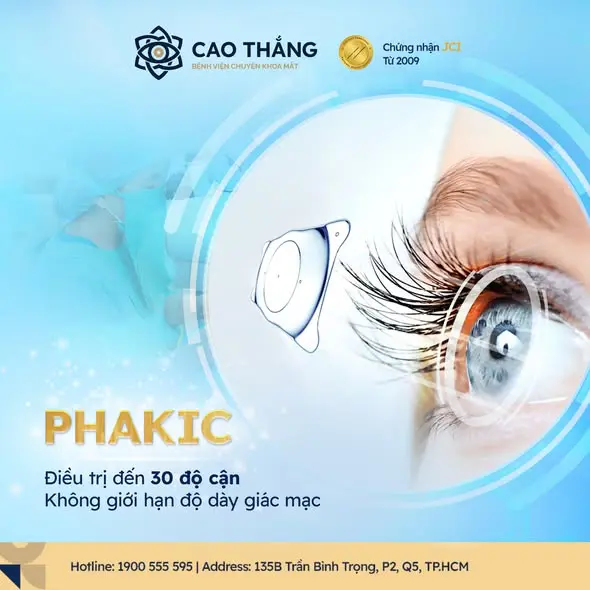
Who is suitable for Phakic surgery?
Phakic is commonly indicated for individuals who:
- Are 18 years of age or older with myopia, hyperopia, or astigmatism
- Have stable refractive error for 6 months to 1 year
- Do not want to depend on glasses or contact lenses
- Have high refractive error or thin corneas and are not suitable for laser surgery
- Do not have serious eye diseases and are not pregnant or breastfeeding
There is no “best” method—only the “most suitable” one.
In addition to Phakic, other technologies such as Femtosecond Pro remain good options for cases of moderate to high myopia. The key point is that every eye has unique characteristics and requires a thorough examination to choose the most appropriate method.

.svg) Hotline
Hotline Appointment
 https://cthospital.vn/
 135B Tran Binh Trong, P.2, Q.5, HCMC
 Opening Hours

 21/02/2026





 0916.741.763